

Editor’s Note: This article was previously published on December 20, 2023. Since “It’s A Wonderful Life” remains a holiday classic, we’re bringing it back.
* * *
Months after his return from combat, actor James “Jimmy” Stewart was still adrift — unmoored in the Hollywood he had previously called home, living with fellow veteran Henry Fonda, and waiting for film offers that just weren’t coming in.
After a couple of months had gone by, director Frank Capra — who had worked with Stewart before in 1936’s “You Can’t Take It With You” — first pitched “It’s a Wonderful Life.” A meeting was set, and Capra described the story to Stewart and his agent Lew Wasserman.
Stewart, who had been adamant about doing a comedy upon his return to Hollywood, was reportedly taken aback at first. “You want me to do what?” he asked, and according to Capra’s notes walked out of his initial pitch meeting. But Capra believed in the strength of the story — and he was equally adamant that Stewart was not just the right person to play George Bailey, he was the only person who could do it.
Stewart eventually sat down to listen to Capra’s pitch in full, and he recalled the director’s awkward description of the story in a 1987 interview for Guideposts.
“‘Now, listen,’ Frank began hesitantly. He seemed a little embarrassed. ‘The story starts in heaven, and it’s sort of the Lord telling somebody to go down to earth because there’s a fellow who’s in trouble, and this heavenly being goes to a small town, and … Well, what it boils down to is, this fella who thinks he’s a failure in life jumps off a bridge. The Lord sends down an angel named Clarence, who hasn’t earned his wings yet, and Clarence jumps into the water to save the guy. But the angel can’t swim, so the guy has to save him, and then … This doesn’t tell very well, does it?'”
The actor said his response was simple: “Frank, if you want to do a picture about a guy who jumps off a bridge and an angel named Clarence who hasn’t won his wings yet coming down to save him, well, I’m your man!”
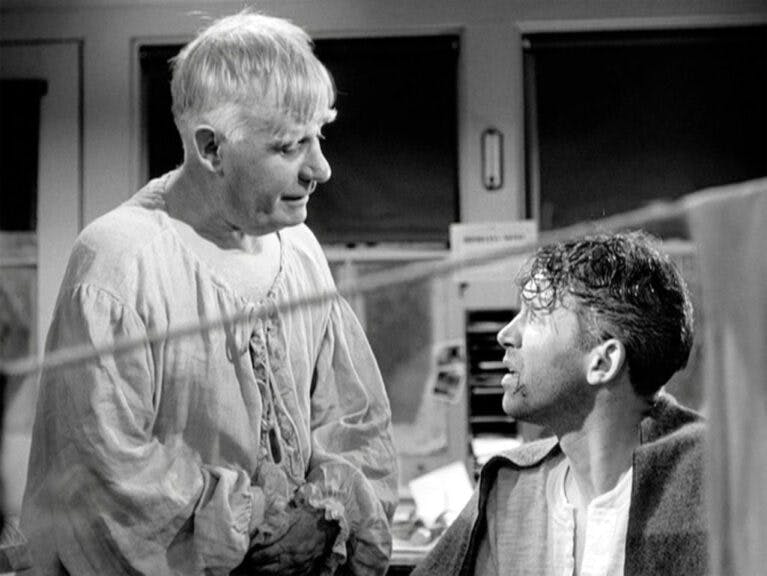
“It’s a Wonderful Life”, produced and directed by Frank Capra. Seen here from left, Lionel Barrymore as Henry F. Potter, Frank Hagney (in background) as Potter’s Bodyguard and James Stewart as George Bailey. Paramount Pictures. (Photo by CBS via Getty Images)
As Matzen explained in a 2016 interview with The Chicago Tribune, Stewart appeared to funnel all the bottled up rage, anxiety, anger, fear, and frustration into the role — making his portrayal of a man on the brink truly blur the line between fiction and reality.
“There’s a scene in the movie where he questions his sanity and he’s got this wild look about him. That’s one scene that really struck me, watching it on the big screen. And the other scene that always made me uncomfortable, but now means so much more to me, is when he’s in his living room and he’s throwing things and screaming at his kids — and his wife and children look at him like, ‘Who is this man? Who is this monster?'” Matzen explained. “And that is so reflective of what millions of families faced, looking at these strangers who came back from the war with this rage. Stewart played it beautifully. He just lets it out.”
Stewart recalled a similar moment in the Guideposts interview, when George Bailey turned to God in desperation — completely unaware that his entire town was also praying for him in the same moment.
“In agony I raise my eyes and, following the script, plead, ‘God … God … dear Father in heaven, I’m not a praying man, but if you’re up there and you can hear me, show me the way. I’m at the end of my rope. Show me the way, God …'” Stewart said, adding, “As I said those words, I felt the loneliness, the hopelessness of people who had nowhere to turn, and my eyes filled with tears. I broke down sobbing. This was not planned at all, but the power of that prayer, the realization that our Father in heaven is there to help the hopeless, had reduced me to tears.”
Capra, who loved spontaneity in his films, kept the powerful moment in the final cut — he even sacrificed some of the film quality to turn a wide shot into a close-up so that the audience could better see “George Bailey’s” pain.
The film was a resounding flop when it was released in 1947 — bringing in less than half of the expected box office haul — but still managed to impress the Academy. In addition to two technical nominations, Stewart received another Best Actor nod, Capra was nominated for directing, and the film was nominated for Best Picture. All five lost — and Capra’s newly-formed studio Liberty Films quickly went under.