
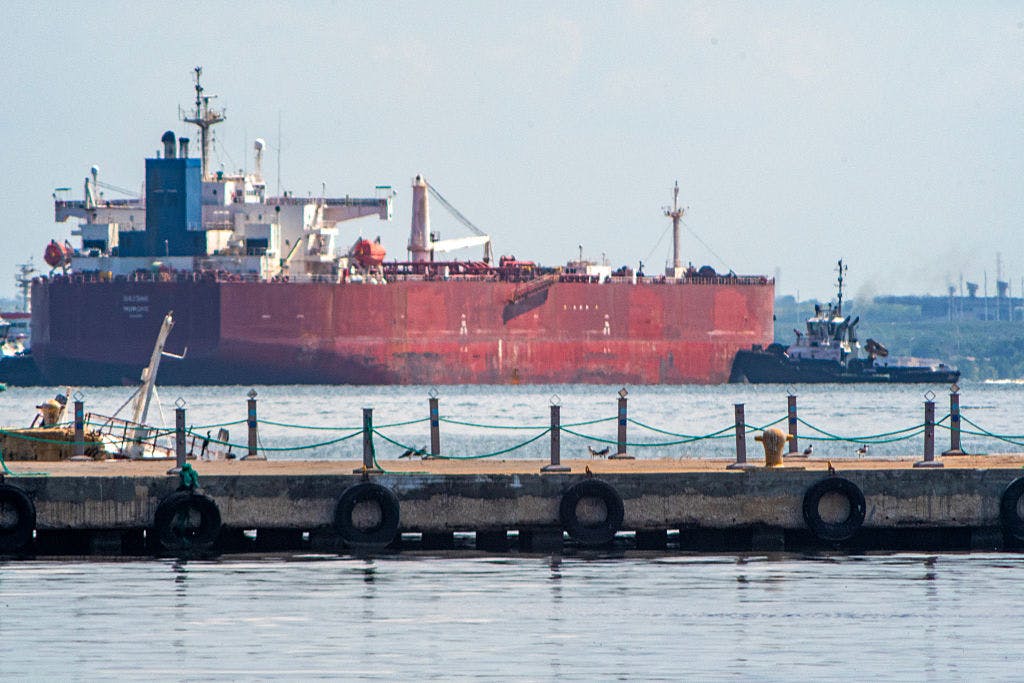
Over a dozen sanctioned oil tankers left port over the weekend in what appears to be an attempt to evade the U.S. blockade around Venezuela following the capture of Venezuelan strongman Nicolás Maduro, according to multiple reports.
At least 16 tankers disguised or hid their locations after leaving Venezuelan ports in the wake of U.S. forces capturing Maduro, The New York Times reported. Four of the fleeing tankers appeared to leave Venezuela on Saturday, shortly after Maduro was detained by U.S. forces, and traveled north of Margarita Island, according to Reuters, which cited satellite images used by TankerTrackers.com.
Some of the tankers have used a tactic called “spoofing,” which means they use fake ship names and misrepresent their positions. Reuters reported that most of the supertankers that left port typically transport crude oil to China.
Four tankers that left port on Saturday were not authorized to do so, according to internal communications from Venezuela’s state-owned oil company, PDVSA, according to the Times. Reuters, however, cited a source with knowledge of the paperwork who said that Venezuelan authorities cleared at least four tankers to leave the country and hide their whereabouts.
A U.S. official did not confirm or deny reports of sanctioned oil tankers attempting to evade the blockade, telling The Daily Wire that the blockade remains in effect and is “focusing on sanctioned shadow vessels transporting sanctioned PDVSA oil.”
Twelve other sanctioned oil tankers that fled in recent days have yet to be spotted. The departures could challenge President Donald Trump’s massive blockade of sanctioned oil tankers, which went into effect on December 16.
Following the capture of Maduro on Saturday, Trump said that the blockade would remain in full force. Secretary of State Marco Rubio added on Sunday that the “quarantine” on Venezuelan oil would “remain in place.”
“That means their economy will not be able to move forward until the conditions that are in the national interest of the United States and the interests of the Venezuelan people are met. And that’s what we intend to do. So that leverage remains, that leverage is ongoing, and we expect that it’s going to lead to results here. We’re … hopeful that it does – positive results for the people of Venezuela, but ultimately, most importantly, for us in the national interest of the United States,” Rubio said.
The United States seized one sanctioned oil tanker used by Venezuela in December, and U.S. forces boarded another tanker around 10 days later. The oil tanker seized by the United States on December 10 was involved “in an illicit oil shipping network supporting foreign terrorist organizations,” according to U.S. Attorney General Pam Bondi. Trump said that the United States would keep the oil the tanker was transporting.
The U.S. blockade was part of a military buildup in the Caribbean that ultimately led to the capture of Maduro over the weekend. After Maduro was in U.S. custody, President Trump said that the United States would take control of Venezuela until a peaceful transition of power could take place.