
WASHINGTON—The Supreme Court appears poised to allow states to keep men out of women’s sports after the majority of justices seemed favorable towards laws from West Virginia and Idaho that make participation in women’s sports contingent on sex.
After three and a half hours of arguments on Tuesday, the justices seemed skeptical of claims from transgender-identifying athletes that laws keeping them off women’s sports teams violate the Equal Protection Clause of the Constitution and Title IX. The outcome of the cases could have far-reaching implications for protecting women’s privacy in bathrooms, locker rooms, and other sensitive spaces.
The justices heard the cases of West Virginia v. B.P.J. and Little v. Hecox. Both cases revolve around laws in West Virginia and Idaho that prohibit men from competing on women’s sports teams.
The strongest pushback against the arguments made against the laws came from Justice Samuel Alito, who pressed lawyer Kathleen Hartnett, an attorney representing a transgender-identifying male athlete from Idaho, about what her definition of sex was.
“Is it not necessary for there to be, for Equal Protection purposes, if that is challenged under the Equal Protection Clause, an understanding of what it means to be a boy or a girl or a man or a woman?” he asked.
“We do not have a definition for the court, and we don’t take issue with the … we’re not disputing the definition here. What we’re saying is that the way it applies in practice is to exclude birth sex males categorically from women’s teams, and that there’s a subset of those birth sex males where it doesn’t make sense to do so, according to the state’s own interest,” Hartnett replied.
“How can a court determine whether there’s discrimination on the basis of sex without knowing what sex means for Equal Protection purposes?” Alito followed up. He also asked Hartnett if she thought female athletes worried about fair competition were bigots.
In a different section of arguments, Chief Justice John Roberts joined in Alito’s skepticism about ACLU lawyer Joshua Block’s reluctance to provide a definition of sex for the court.
“Title IX prohibits discrimination on the basis of sex. It’s a statutory term, it must mean something,” Roberts said. “You’re arguing here there is discrimination on the basis of sex, and how can we decide that question without knowing what sex means in Title IX?”
Justice Brett Kavanaugh appeared inclined to let the debate play out at the state level, noting that 27 states have protected women’s sports while the other 23 allow males who identify as females to compete in the women’s division.
“Why would we, at this point, just the role of this court, jump in and try to constitutionalize the rule for the whole country while [there’s] still, as you say, uncertainty, debate — while there are still strong interests on the other side?” he said.
Kavanaugh also noted that sports are often a “zero-sum game” and that even one transgender-identifying athlete allowed on a women’s team could have an outsized impact.
At a press conference after the case, Alliance Defending Freedom lawyer John Bursch told The Daily Wire that he believes the issue should be national and that women in California and Massachusetts should not have their right to fair competition taken away.
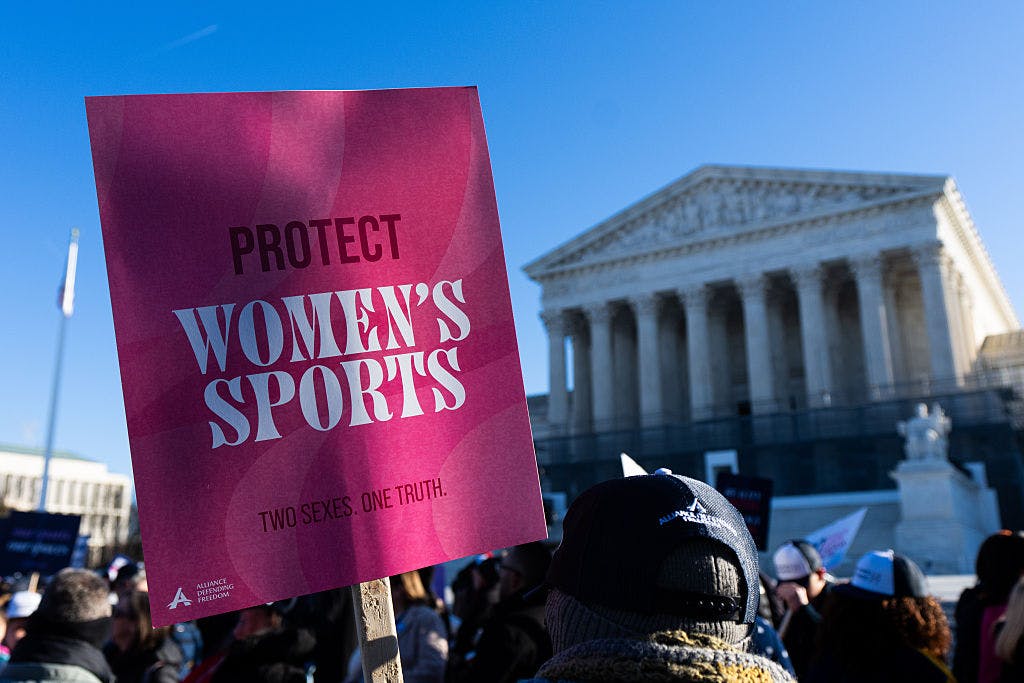
During arguments, demonstrators on both sides held competing rallies. One woman from North Carolina who was holding a sign in favor of protecting women’s sports told The Daily Wire that she got on a bus at 3:00 a.m. to travel up to Washington, D.C., for the demonstration.