
It’s been hard to miss the ongoing effort to rewrite America’s history, to cast the United States as a kind of international supervillain.
Just a couple of weeks ago, I spent the better part of an hour dissecting the 25,000-hour documentary from Ken Burns about The Revolutionary War, which told a flagrant lie (either explicitly or by implication) every ten minutes or so. The point of the documentary, of course, was to convince young people — many of whom will be forced to watch the film in public school — that America is a terrible country founded by racist misogynists who stole all their ideas from the Indians. As it turns out, according to Ken Burns, the Indians were philosophers on the level of Plato or Aristotle. You see, when they weren’t busy converting human beings into stew, or arranging beads into flamboyant patterns because they were too primitive to come up with a written language, the Indians were basically giving Ben Franklin all of his ideas, under the table.
Correcting the historical record with our own projects — on the scale of Ken Burns’ work — could not be any more urgent, which is why, very soon, I intend to do that. But in order to understand the extent of the propaganda we’re up against, it’s important to recognize that Leftists are not simply rewriting our history. They’re also attempting to rewrite some of the most classic expressions of American culture — including films and books that are widely read by children. In particular, there has been a very well-coordinated and well-funded effort to propagandize children into believing that evil does not exist — and that any individual who seems to be evil is, in fact, a very misunderstood victim of circumstance.
To illustrate what I’m talking about, listen to this musical number from the 1961 Disney film “One Hundred and One Dalmatians.” It’s sung by Roger about the villain of the story, Cruella de Vil — much to the delight of the family’s pet Dalmatian Pongo.
See what you notice about the lyrics:
Credit: Walt Disney Productions
If you’re watching the video podcast, the first thing that probably jumped out at you is the quality of the animation. This was clearly put together by artists who cared about what they were creating. That’s why it holds up, more than 60 years later. It’s clearly superior to the CGI slop that we’re all used to. And it certainly looks a lot better than the modern remake of this same story, which we’ll get to in a second.
But the important part, for now, is the lyrics. He says, “If she doesn’t scare you, no evil thing will. To see her is to take a sudden chill.” Then he compares Cruella de Vil to vermin and says she’s an “inhuman beast” who “ought to be locked up and never released.”
Nothing in the film ever contradicts these statements. They’re obviously true. Cruella de Vil is a genuinely horrible person. Her goal is to steal puppies and murder them. In her first appearance in Roger’s home, she puts out a cigarette in his wife’s muffins — which, to be clear, is not a euphemism. She flicks her cigarette over the coffee. She openly mocks Roger and his home.
Watch:
Credit: Walt Disney Productions
At no point in this scene, or in this entire film, does Cruella de Vil display a hint of humanity. So, for any child watching this, the lesson is unmistakable. Disney is telling its young audience that evil exists — and that some people are so evil that they belong in prison for the rest of their lives. You shouldn’t interact with them. If you do, they will take advantage of you. They will destroy everything you care about. They will defile your baked goods.
They will walk around your house like Hillary Clinton from that meme. The one where she’s in that house in East Harlem, visibly shocked that it’s not up to her standards.
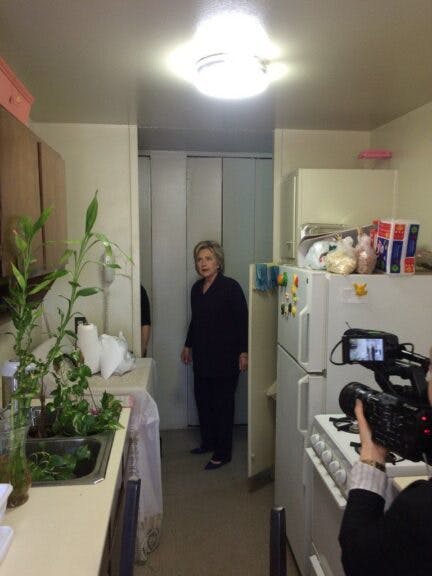
They will make their contempt for you as clear as they possibly can. They have no redeeming qualities. They are a pure negative for you, and for society at large.
Disney didn’t dilute this message in any way because, in 1961, no one was worried about being called a racist for teaching basic, fundamental life lessons to children. And religion was much more important to most Americans than it is today. A Christian nation is capable of recognizing that some people will receive eternal damnation because they are evil. They don’t deserve any of our time or sympathy.
But the modern remake of this film, called “Cruella,” delivered a very different message. It was released back in 2021. And it completely rewrites the character of Cruella de Vil to make her the hero. And it begins with this origin story, in which Cruella’s mother is killed by Dalmatians right in front of her, while she looks on in horror. This is one of the worst scenes I’ve ever had to look at, and now I’m going to make you endure it as well.
This is completely real.
Watch:
Credit: Walt Disney Productions
Before we even get into how dumb this scene is — just look at it. The quality isn’t in the same universe as the animated film that was released six decades earlier. The sky in the background is clearly fake. The weather is clearly fake. The Dalmatians are clearly fake. But, unlike with the animated film, they’re not “fake” in a way that’s visually appealing or interesting or artistic. It looks like the graphics you might see in a mall arcade, or a game on the original Playstation. There’s no sense that any artist cared about how it looked, or spent any amount of time on it.
And appropriately enough, along with this aesthetic decay, the messaging of the film has fallen apart, as well. In “Cruella,” we’re told that Cruella isn’t actually a bad person. Instead, she suffered a horrible personal tragedy as a child. Her mother died right in front of her, because CGI dogs ran after her, as you just saw. And we later learn that those dogs were secretly ordered to attack via a dog whistle by another character, called the Baroness. So Cruella spends the rest of the movie getting vengeance on the Baroness, who killed her mother. But the big twist — spoiler alert — is that the Baroness is Cruella’s actual mother, and the woman who was pushed off the cliff by the Dalmatians was a maid who was told to raise Cruella from a young age.

So to recap: In the original film, Cruella is evil and belongs in prison. It’s pretty simple. But in the re-make, Cruella’s mother killed Cruella’s stepmother using Dalmatians who can be ordered to commit murder via dog whistle, and Cruella was horribly scarred by this. So Cruella plots revenge against her own mother, has the police arrest her, and then gives some Dalmatians away as a gift to her friends, since she’s now conquered her Dalmatian phobia.
In other words, moral clarity — not to mention narrative clarity — is completely absent from the “remake.” The message for children in the remake is — what exactly? Is the message that your mother may not actually be your mother? Maybe she’s a secret murderer. Or maybe the message is that evil characters who are literally named “Cruel Devil” are actually misunderstood, and have simply internalized a lot of emotional trauma from freak accidents that occurred in their past.
When this film came out, it was tempting to dismiss it as a terrible film, and move on with your life. That’s what most people did. But it’s actually part of a much larger trend. For the past decade, Hollywood has continued to follow this exact same template. They’ve taken an obviously, unequivocally evil classic character. And then they’ve come out with a new film or show, which makes the case that actually, that character was the good guy all along.
The most recent example of this tactic is the upcoming animated film “Steps,” which is due out next year from Netflix.
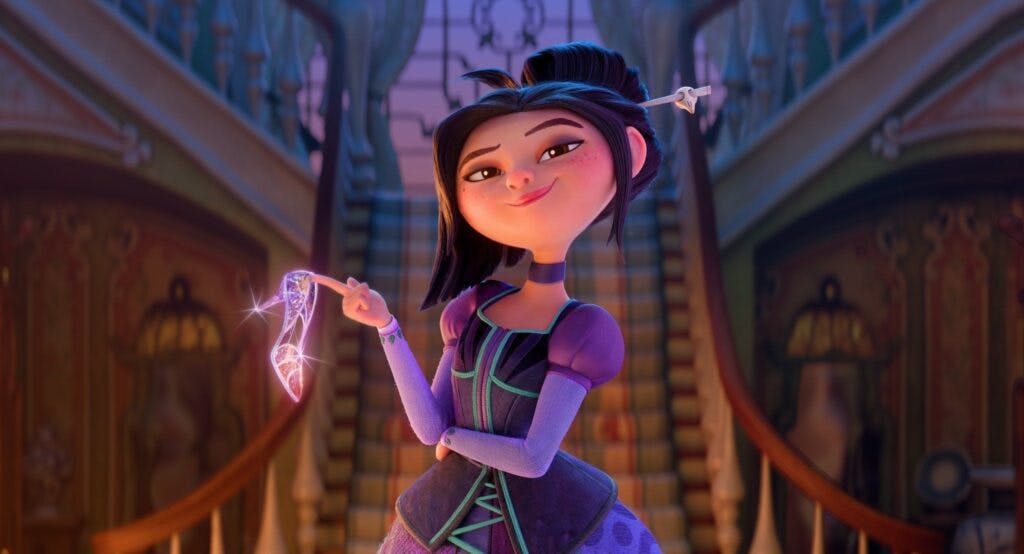
Credit: Netflix/Paper Kite Productions
Here’s how Netflix’s official promotional blog describes the idea behind this new film. This is a pitch that feels like it was produced by Chat GPT, and then Netflix automatically hit the green light, without making any revisions whatsoever.
Here it is.
Think you know Cinderella’s ‘evil’ stepsisters? Think again! When misunderstood Lilith is blamed for hijacking the Royal Ball with a stolen magic wand, she accidentally turns her sister Margot into a frog and allows the kingdom to fall into the hands of a prince-obsessed mean girl. Now Lilith must team up with Cinderella (and a surprisingly dreamy troll) to save the kingdom, repair the fractured fairy tale, and prove that even so-called villains deserve a shot at happily ever after.
So the villains are actually good. They don’t deserve to spend the rest of their lives in prison. They’re not vermin. They “deserve a shot at happily ever after,” no matter what they’ve done. And the new villain, to take the place of the stepsisters, is a “prince-obsessed mean girl.” For her part, Cinderella is teamed up with a “surprisingly dreamy troll.” They’re really sticking it to the patriarchy, in other words. It’s a bit like that Snow White remake no one watched, where Rachel Zegler described Snow White as a strong independent woman, who doesn’t need any prince.
This is the kind of assembly-line scriptwriting that, for the past decade, has defined pretty much every major Hollywood remake of a classic. And every time they do it, these filmmakers convince themselves that they’re doing something brave and transgressive.
Here’s a quote from the director of this new Netflix Cinderella movie.
This story is, at its core, about two very different sisters — one who fits perfectly into this fairy tale kingdom and one who doesn’t — realizing they’re more alike than different. It’s such a personal story for me because, growing up as an awkward, artsy Taiwanese kid in suburban New Jersey, I often felt like an outsider, like ‘happily ever after’ wasn’t meant for me. I wanted to create a film for everyone who has ever felt like they didn’t belong — and show how a single act of kindness can change everything.’
The most obvious response to this, of course, is that this particular Netflix director — a woman who, according to her website, specializes in “classical piano, ballet, fine art, classical violin, graphic design, and more” — is a pathological narcissist. She’s convinced herself that she’s a victim because she was “awkward” and “artsy,” whatever that means. Apparently, we’re supposed to believe that rich Taiwanese kids in suburban New Jersey are an oppressed demographic. And now, as a result of that oppression, she’s going to force Netflix subscribers to watch her “personal story,” even though she’s not working on a documentary or biography about her own life. She’s making a Cinderella movie — allegedly.
But really, this director’s job is not to create anything. Her job is to erase the Cinderella story that everyone’s familiar with — the one where the stepsisters are complete garbage. At one point, lest we forget, the stepsisters destroyed Cinderella’s dress and assaulted her, to the delight of Lady Tremaine, the stepmother.
Watch:
Credit: Walt Disney Productions
As a kid in the 1950s, if you saw this, you’d recognize that the stepmother and the stepsisters are not good people. And the film doesn’t suggest otherwise, at any point. There are no excuses for their behavior. There’s no sob story about how Dalmatians somehow murdered their mother. They’re just bad people. And in the end, they lose — and that’s a moment to celebrate, because it’s good when bad people lose.
When you make Cinderella a story about how the evil stepsisters really aren’t so bad — and in fact, how they’re really the heroes of the story — then you aren’t simply producing another generic DEI slopfest.
You’re also trying to confuse children about good and evil. And you’re trying to erase the Christian themes of the Cinderella story, which were particularly evident in the Grimm Brothers’ version of the story in the 1800s. In the Grimm Brothers’ version, the stepsisters suffered a biblical, Old Testament-style punishment in the end.
In the end, during [the] wedding, as she walks down the aisle with her stepsisters as her bridesmaids, the doves fly down and strike the two stepsisters’ eyes, one in the left and the other in the right. When the wedding comes to an end, and Aschenputtel and her prince march out of the church, the doves fly again, striking the remaining eyes of the two evil sisters blind, a punishment they had to endure for the rest of their lives.
This was the way it worked in old fairy tales. The villains were very evil, and in the end, very bad things happened to the very evil people. In the Disney version, the ending wasn’t quite so graphic. They dialed down the Old Testament references a little bit. But even so, the stepsisters didn’t win in the end. But now, less than a century later, Netflix has decided that the stepsisters are indeed the heroes. They “deserve a shot at happily ever after,” we’re told.
Imagine being a child raised in a culture where everything — including basic biology and fundamental tenets of morality and Christianity — is subjective. That’s the point here. The idea is to convince the youth that evil isn’t a legitimate concept, so that they can indoctrinate them into supporting — and committing — acts of evil.
Works that have overt Christian and right-coded themes are particularly under attack. Take the “Rings of Power” series by Amazon. I haven’t seen it, but from what I can tell, the show has decided to portray the Orcs as sympathetic figures — even though Tolkien did the exact opposite, for a reason.
This is from a website called “Bounding Into Comics.”
In the opinion of The Lord of the Rings: The Rings of Power showrunners, their Season 2 decision to ‘humanize’ the Dark Lord’s orc armies is far from controversial because not only does the change provide better opportunities for storytelling, but it also falls directly in line with Tolkien’s writings. … The Orcs in The Rings of Power are shown as brutal but oppressed foot soldiers, their lives concerned not just with war and pillaging, but also achieving a future where their families can exist as more than tools for Lord Sauron to use in service of his ambitions.
So they’re claiming Tolkien would’ve humanized the orcs — he just never got around to doing it. But fortunately, we have the Amazon show runners to swoop in, decades later, to tell us what Tolkien meant to say, in an extremely heavy-handed fashion. There’s this line of dialogue in the Amazon show, for example, from an Orc named Glug.
The preparations are nearly complete, Lord-father. But…we are safe here. We have a home. Must we go to war again? You told me Sauron was dead. Let us leave him that way.
It’s enough to make you shed a tear for the orc hordes. And then there’s this scene, where we get to see an Orc family, lamenting the prospect of more war:
Watch:
Credit: Amazon MGM Studios
At this point, they might as well throw in a scene where an Orc goes postal because his health insurance claim is denied. They’re committed to taking you out of the world that the author created, and shoe-horning all of the most cliched scenes imaginable into the plot. And they don’t seem to care about the fact that they’re completely undermining everything the author was intending to do. They’re making this story entirely indistinguishable from every other show on television.
And in some cases, it’s a commercially successful approach. We can’t deny that. “Wicked” — a story that’s billed as a kind of prequel to the Wizard of Oz — was one of the biggest box office hits of the decade. And it was successful because it took the same “edgy” and “subversive” angle, where the villain is actually a misunderstood hero. And for good measure, they’ve thrown in some transparent political messaging.
Watch:
Credit: Universal Pictures/Mark Platt Productions
Wickedness is “thrust upon” some people, we’re told. In particular, in this case, wickedness is thrust on a black woman by the white guy (Jeff Goldblum) and the Asian woman (Michelle Yeoh). The non-black characters use their institutional power to demonize an innocent person of color, as they so often do.
The message, once again, is that, contrary to what you learned in “The Wizard of Oz,” “wickedness” isn’t actually a legitimate concept. Instead, it’s a way to scapegoat minorities. The South Side of Chicago isn’t more dangerous than Iraq because wicked people live there. It’s more dangerous than Iraq because the government is scapegoating those poor people. That’s the takeaway. And if you’re 10 years old, which describes much of the audience for this film, you’ll fall for it.
There are too many more examples of this phenomenon to mention, from the new Joker movies, Dracula, the show Lucifer, and so on. But we’ll finish with how the 1959 film “Sleeping Beauty” has been defiled by Hollywood. This is a scene from the film “Maleficent,” which came out around a decade ago. This is where the evil fairy appears and puts a curse on the newborn child.
Watch:
Credit: Walt Disney Studios Motion Pictures/Joe Roth Films
As you can tell, the fairy isn’t messing around. She wants the kid dead. And she’s upset because she wasn’t invited to the party. That’s it. She’s an evil fairy. There’s nothing more to it.
But in the live-action film, there’s a lengthy backstory. The fairy has been betrayed in some horrible way by the king. And so the fairy shows up to place the curse on the child. But it’s not the same curse.
Watch:
Credit: Walt Disney Studios Motion Pictures/Joe Roth Films/
Again, the CGI and the acting are horrible, to the point that it’s distracting. It’s much harder to watch than the cartoon from the 1950s. But they also added a completely new part of the curse. Now the fairy offers an “out” to the child. She needs to find true love to lift the curse. And what do you know? In the end, the evil fairy Maleficent comes to love the child, and saves the child’s life.
It’s impossible to overstate how universal this trope has become, particularly in children’s entertainment. The term “psy-op” is overused, but it’s hard to think of another way to describe this. It’s a full-court press that’s intended to convince children that objective morality does not exist, and that Christian ethics is a simplistic and outdated approach in a very diverse, “complicated” world.
In response, you might be tempted to say, well, Hollywood is really just out of ideas. So they’re going through all of these classics, and inverting the villains, as a way of generating some new content. But if that’s the case, where are the Right-wing ret-cons? Why aren’t we getting a follow-up to “Beauty and the Beast,” where Gaston is vindicated as the hero he actually was?
All he did was work out, eat eggs every day, and defend the town — and a vulnerable woman — from a rampaging, magical beast that came out of nowhere. And he did it all in style.
Watch:
Credit: Walt Disney Pictures
I’ve made the case before that Gaston is really the hero of the story. In fact I argued that a number of Disney villains were really the heroes. I meant it as a joke at the time. But Disney doesn’t see it as a joke, apparently. Admittedly, even though you could make an argument for Gaston — even jokingly — it’s not the easiest argument to make, if you watch the original “Beauty and the Beast.” So it’s ripe for a full-on, Right-wing follow-up that flips the script. Where’s our big-budget Netflix animated film called “Gaston,” with a consulting credit to that guy Raw Egg Nationalist, where Gaston bravely defends his village from a marauding, foreign beast? As Netflix said, every villain deserves a happy ending, or whatever. So where’s Gaston’s happy ending? When is that coming out?
We all know the answer to that question. Gaston’s not getting a redemption arc because he’s not an insufferable shrew, or a jealous stepsister, or a demented terrorist who paints his face, or a literal witch, or an old hag who’s jealous she didn’t get invited to a party, to the point that she’ll murder a child. In short, Gaston’s not getting a redemption arc because, in that “modern remake” that humanizes him, he’d be a normal white guy who takes pride in himself and his community. Those are the values that Hollywood abhors. And those are the values that Hollywood doesn’t want your children to learn.
This is a relatively new phenomenon, and it’s important to distinguish it from the general trend towards anti-heroes. I’m aware that the whole “anti-hero” thing became really popular back with “Breaking Bad,” “Sopranos,” et cetera. It’s still going strong. But there are several key differences here. For one thing, those shows aren’t aimed at children. For another, they’re actually good shows. They’re not unimaginative and boring, complete with generic and unwatchable CGI. They also have stakes and tension — which these remakes lose entirely, by making the villains seem sympathetic at heart.
But most importantly, those shows are original. They aren’t transparent attempts to rewrite our culture and reprogram the morality of an entire generation. It’s now very evident that, above all else, that is Hollywood’s goal. They want your children to believe they live in a world without villains, and where no individual can truly be described as evil. So ask yourself this question: What kind of person or institution benefits when an entire generation is raised to believe that morality is entirely subjective? And what does it mean when those people or institutions have billions of dollars, and control of the entertainment industry?
Every day we hear another story about some violent vagrant criminal released from jail — or never jailed at all — by some judge — almost always a female — who wants to see the good in the evil scumbag and give him a second (or 10th or 30th) chance. I’m not saying those judges were influenced by a bad “101 Dalmatians” remake. I’m saying they’re part of the same cultural trend. Reflecting and driving it at the same time.
This means that, as a parent, you’re up against some very powerful — and very sinister — forces. It also means that, before they’re taken offline, you should pull up some of the Disney films from the 1950s and 60s that I mentioned. Screen them for your kids. It’s an entire era that everyone in the entertainment industry would rather you forget about. But good and evil do exist. And it’s never been more important that your children understand that.
Christmas Sale – Get 40% off New DailyWire+ Annual Memberships