

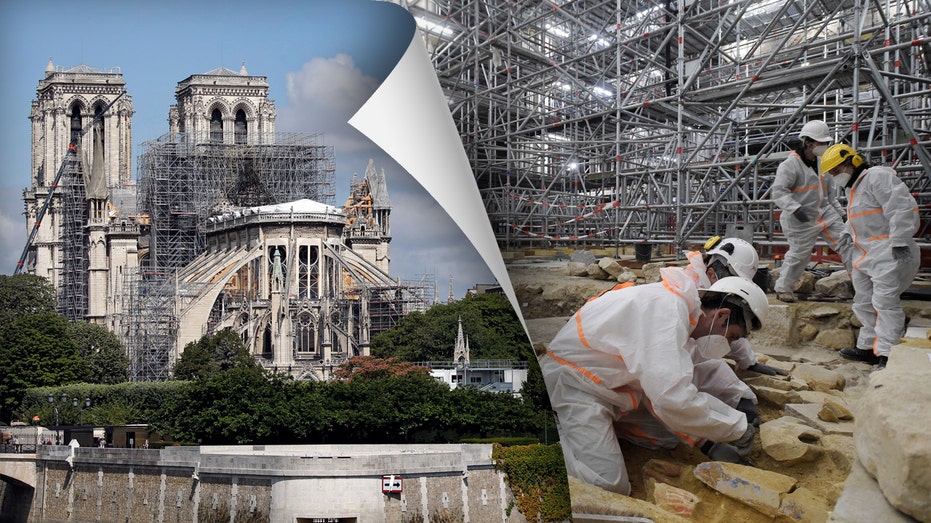
Since the devastating fire that broke out at the Notre-Dame Cathedral in Paris, France on April 15, 2019, an enormous restoration project has been underway.
In addition to rebuilding, archaeologists have explored the site, unearthing thousands of ancient findings.
When artifacts are discovered, answers aren't always uncovered with them. It often takes more research and investigation in order to grasp a better understanding of the story behind the find.
12-YEAR-OLD BOY STUMBLES UPON STUNNING ANCIENT FIND WHILE WALKING DOG IN ENGLAND: ‘RELATIVELY RARE’
Back in 2022, archaeologists discovered two lead sarcophagi under the transept crossing of the cathedral. Sarcophagi were containers used to hold a coffin. They were reserved for the burying of wealthy individuals and leaders.
One of the deceased was quickly identified as Antoine de La Porte, a canon of the cathedral who died in 1710.
The other remained unknown, but has recently been hypothesized to be the famous French poet, Joachim du Bellay, who died in 1560, according to a September 17, 2024, news release from the French National Institute for Preventive Archaeological Research (INRAP).
ARCHAEOLOGISTS DISCOVER UNIQUE ARTWORK IN ENGLAND DATING BACK TO THE EARLY 2ND CENTURY
Du Bellay was believed to have been buried in the cathedral beside his uncle at the request of his family, but his grave was never found.
Éric Crubézy, professor of biological anthropology at Toulouse 3 University and research director and his team put forth the hypothesis based on evidence such as the fact that an autopsy revealed that the individual suffered from bone tuberculosis and chronic meningitis, which was rare at the time, and parallels the medical history of du Bellay.
Additionally, the femur structure of the man was in line with someone who spent a lot of time riding horses, according to Euronews. This detail, again, is in line with the life of du Bellay.
"He matches all the criteria of the portrait: he is an accomplished horseman, suffers from both conditions mentioned in some of his poems, like in ‘The Complaint of the Despairing,’ where he describes 'this storm that blurs (his) mind,' and his family belonged to the royal court and the pope's close entourage," Crubézy said, per La Croix International.
Even though there is evidence to support the hypothesis, there are still researchers who have their doubts.
"Certain elements do not support this hypothesis: isotope analysis of the teeth indicates that the individual lived in the Paris region or Rhône-Alpes until he was 10 years old. However, we know that Joachim du Bellay grew up in Anjou," Christophe Besnier, an INRAP archaeologist and excavation leader, told the outlet. "Additionally, just because his grave wasn't found during the 1758 excavations of the Saint-Crépin chapel, doesn't mean his remains weren't there."
Since the fire of 2019, there have been more than 100 burials identified, and 80 excavated in the cathedral, according to INRAP.
More than 50 archaeologists have been on site, working on the 14 operations that have taken place, the source notes.
As of now, reopening of the cathedral is planned for December 2024.