

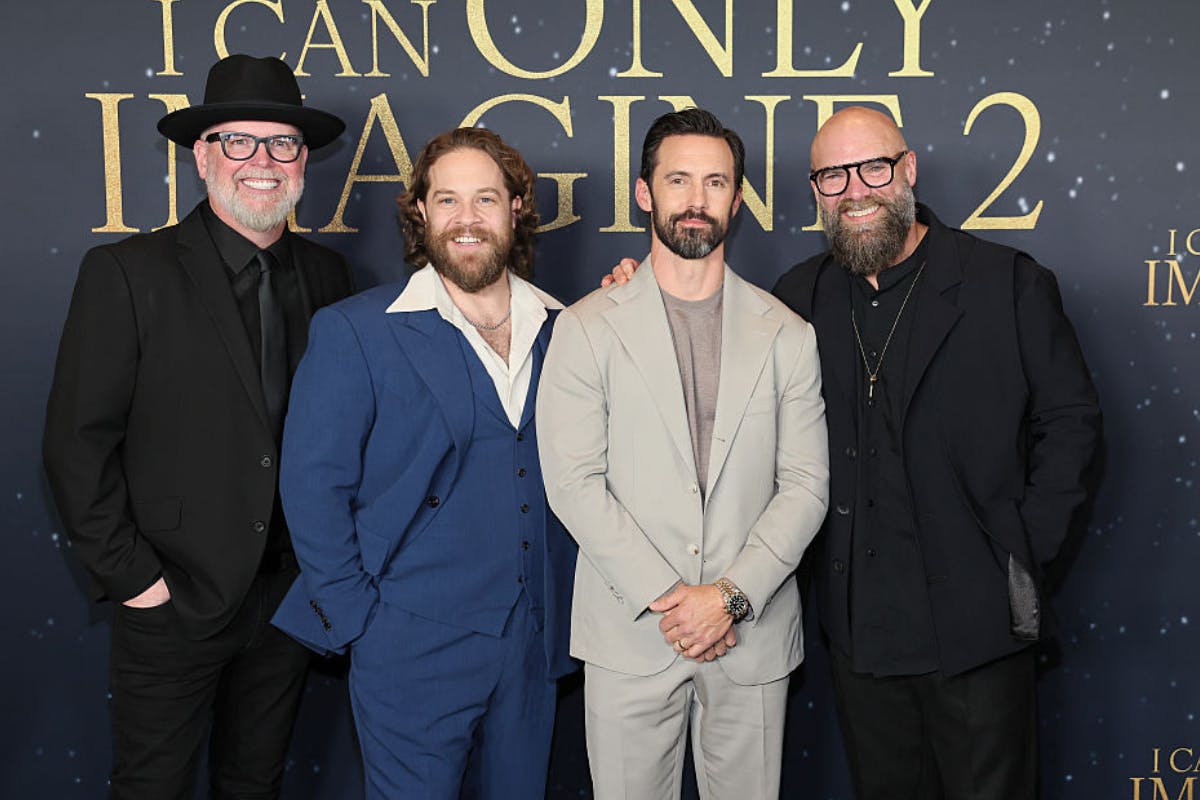
After The Original Smashed The Box Office, There Is More Story To Tell In ‘I Can Only Imagine 2’

It’s opening weekend for “I Can Only Imagine 2” — the sequel to the faith-based smash hit “I Can Only Imagine,” which raked in $83 million in 2018, paving the way for more Christian entertainment.

“I Can Only Imagine 2” highlights the real story of Tim Timmons, a Christian singer who joins the hit-making band MercyMe at the height of the group’s career.

Timmons’ own challenges helped MercyMe lead singer, Bart Millard, to face problems of his own.

MercyMe’s “I Can Only Imagine” was the song behind the first film, while the second film’s foundation is the song “Even If,” written by Timmons about his terminal cancer diagnosis.

Diagnosed with stage four cancer 25 years ago and given five years to live, he still has tumors on his liver today — but his battle with the disease and how he leaned on his faith, all while inspiring his bandmates to get through their hardships, is on full display in “I Can Only Imagine 2.”

“My story isn’t cancer; my story is finding joy through it. I think cancer is the dumbest story I know, but how we get through it is the beautiful story,” Timmons told The Daily Wire at the Nashville premiere. “For me to have this shown to the whole world and to invite the world to be grateful in the midst of grief is really powerful.”

When Timmons joined MercyMe, the band was selling out arenas and inspiring a generation, but you will see in the sequel that much was going on behind the scenes.

Millard, who grew up with an abusive father, is threatened by his past demons in the second film, which affects his already fragile relationship with his son, Sam. It’s Timmons who brings a new perspective to Millard’s life as the leading man learns about his bandmate’s hardships and health battles, which help Millard repair the relationships in his own life.

“At the height of our career, when things seemed to be going great, is when we were struggling the most at home,” Millard told The Daily Wire. “I appreciate the fact that this movie tapped into that because it’s real. If people can walk away saying … I’m not in this alone, then it’s worth it.”

Timmons is portrayed by actor Milo Ventimiglia, who said “I Can Only Imagine 2” will help others find their inner strength.

“For me, it just reaffirms the way of being out in the world,” Ventimiglia told The Daily Wire. “We all go through those tough times in life; put your faith to work.”

.@LyndenBlake interviews the cast, crew, and special guests on the red carpet for I Can Only Imagine 2, out today! ✨

Watch the original film, I Can Only Imagine, now streaming on DailyWire+. pic.twitter.com/XaQB1y1MwN

— DailyWire+ (@dailywireplus) February 20, 2026

At the red carpet rollout for the movie in Nashville, The Daily Wire’s own Reagan Conrad joined other big names from the Music City, including Amy Grant, to celebrate the film’s release.

Conrad said the sequel is proof there is a desire in the culture for more Christian movies.

“It is really encouraging because I know it is going to reach so many people with the word of Jesus,” Conrad said.

“I Can Only Imagine 2” is now playing in theaters everywhere. The original film, “I Can Only Imagine,” is now playing on DailyWire+.

Germany’s Ruling Party Backs Social Media Curbs For Children

Germany’s ruling conservatives on Saturday passed a motion to ban social media use for under 14s and introduce more stringent digital verification checks for teenagers, building momentum for such limits in Germany and elsewhere in Europe.

At a party conference in the city of Stuttgart, Chancellor Friedrich Merz’s Christian Democratic Union also called for fines for online platforms that failed to enforce such limits, and European Union-wide harmonisation of age standards.

A growing number of countries, including Spain, Greece, France and Britain, are looking at similar social media bans or restrictions on accessing platforms like TikTok or Instagram.

It follows the example of Australia, which last year became the first country to force platforms to cut off access for children.

European nations are more broadly ratcheting up pressure on social media companies, risking a backlash from the United States. President Donald Trump has threatened tariffs and sanctions if EU countries impose new tech taxes or online regulations that hit U.S. firms.

“We call on the federal government to introduce a legal age limit of 14 for the use of social networks and to address the special need for protection in the digital sphere up to the age of 16,” said the motion that passed on Saturday.

Merz’s coalition partners the Social Democrats have also backed social media curbs for children. Pressure from both parties in the coalition makes it increasingly likely that the federal government will push for restrictions.

However, under Germany’s federal system, media regulation is a state‑level responsibility and states must negotiate with each other to agree consistent nationwide rules.

The ban could affect children like those at the Cardinal Frings Gymnasium in the city of Bonn, several of whom a day earlier were scrolling on their phones in the school grounds.

“I think it’s fair, but I think it should be up to the parents to decide whether to forbid it, not the state,” said 13-year-old Moritz, who says he only watches YouTube.

“For children under 12 it should be forbidden, but from age 12 onwards I think children can already distinguish between what is fake news and what is not.”

His classmate Emma, 13, almost exclusively uses Snapchat, but has a time limit on her phone.

A ban would be “kind of unusual, because you get used to sending your snap in the morning before school, or what my friends do, like just scrolling through Instagram or TikTok for a bit,” she said.

Ella, 12, scrolls through social media several times a day.

“So I have TikTok and Instagram myself, but I understand that it’s all addictive, and the more you scroll, the more you want to see.”

Teacher Till Franke said that for many of the children, “it would be a shock at first, because of this daily use of social media.”

But eventually, the students would get used to it, he said, “because they would find other niches where they could communicate with each other.”

(Andreas Rinke, Stephane Nitschke and Petra Wischgoll; Writing by Matthias Williams; Editing by Jan Harvey)

About Us

Virtus (virtue, valor, excellence, courage, character, and worth)

Vincit (conquers, triumphs, and wins)