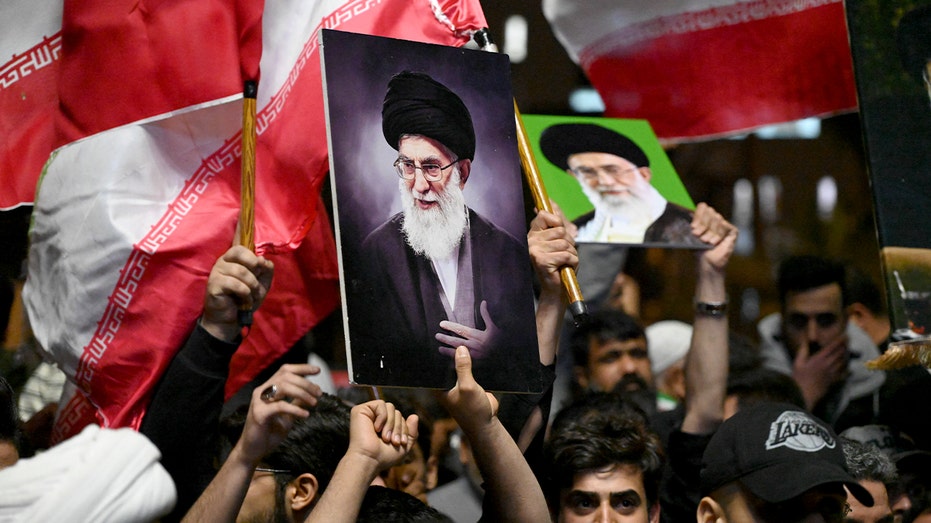

What will the Iranian government look like after this military conflict? This question is being asked across the media. And, we are told, it could be a disaster, depending on who or what replaces the current Islamic dictatorship.
Well, this is interesting.
So, I will answer this apparently complicated question: We have no idea what it will look like. In fact, since we have no desire to be involved in any kind of postwar "democracy project," how can we know?
We have declared to the Iranian people that once most hostilities have ended, it is up to them to overthrow the government. And, logically, it will be up to them to determine what replaces it — especially if we have no intention of getting involved in a postwar project.
MIKE POMPEO: OPERATION EPIC FURY IS RIGHTEOUS — AND REGIME CHANGE MUST FOLLOW
Of course, hostility to "democracy projects" stems largely from our experience in Iraq, where the word "democracy" was used constantly as justification for fighting that war. It did not turn out well, and we suffered significant casualties.
But every case is unique. Not all conflicts are Iraq. Post-World War II, we played a significant role in establishing governments in Japan and Western Europe. We followed with the Marshall Plan in Europe, and that effort proved successful.
But if one is going to ask about postwar Iran — if we have no intention of playing a role in establishing a new government, even though noninvolvement carries consequences — then the question is either unserious or unknowable. Most of those asking it do so out of concern about what might happen.
AMERICA STRIKES IRAN AGAIN — HAS WASHINGTON PLANNED FOR WHAT COMES NEXT?
The more important question, it seems to me, is whether we will play any role at all in postwar Iran, especially if the nature of the new government is a matter of serious consequence. It clearly is. I am not arguing for a "democracy project," but I am suggesting that a hands-off approach can be problematic, if not disastrous.
Thus, the question before us is not what a postwar Iran will look like, but whether it is in our best interest, for a variety of reasons, to get involved in shaping that outcome — and, if so, to what extent and in what way.
The truth is that if we are completely hands-off, we risk a rerun of the regime we have destroyed. There will undoubtedly be remnants of the existing regime, or even a sizeable population hellbent on sabotaging the establishment of a democratic or nonauthoritarian government. If they are not disarmed, they may well succeed in a power struggle for control.
CLICK HERE FOR MORE FOX NEWS OPINION
Moreover, let us not pretend that China, Russia or Turkey — and perhaps others — will not see our absence as an opportunity to influence or impose their will on Iran. In short, to do nothing would be a potentially dangerous and grave mistake.
I am concerned that not enough thought has been given to this, particularly if our position is to leave the matter entirely to others. This is not to say that we should commit troops to impose democracy on the country. But there are other options well short of that.
Again, Iran is not Iraq. The Persian people share many, if not most, of our Western values. Persian culture has been among the most advanced of any civilization. Its roots are ancient, and its history is marked by accomplishments in education, science and the arts.
Of course, the immediate matter at hand is the total defeat of the regime that hijacked the Iranian government, enslaved its people and has been an existential threat to our country and the world for nearly half a century. But we can walk and chew gum at the same time. The nature of a postwar Iranian government is a crucial issue for both the Iranian people and our country, lest the battle we are fighting today be for naught.
CLICK HERE FOR MORE FROM MARK LEVIN