

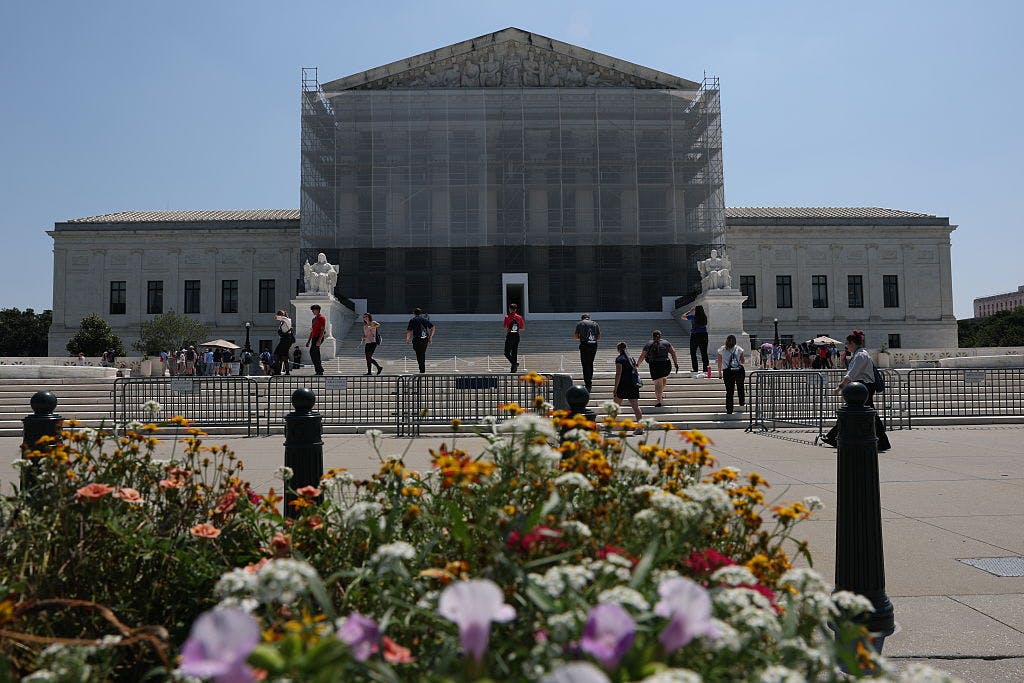
Anyone following the news in recent months has likely heard that there is a constitutional crisis going on. Anyone paying close attention, not to the hysterical headlines but to the actual legal issues at play, should understand that there is indeed a constitutional crisis, but it has nothing to do with Trump being a tyrant. No, the real crisis is not in the executive branch. The crisis stems from Article III of the U.S. Constitution, which states that “The judicial Power of the United States, shall be vested in one supreme Court, and in such inferior Courts as the Congress may from time to time ordain and establish.” (emphasis added). In case it isn’t clear, judicial power is invested in the Supreme Court. All other federal courts are created by statute (they have no necessary constitutional right to exist) and are inferior to the Supreme Court.
Yet, an observer might be forgiven for thinking this is not the case. The federal district courts (which have jurisdiction over a particular district within a state and are subject to the rulings of the higher courts, especially the U.S. Supreme Court) seem to have almost unlimited control over the rule of law in America today. This is indeed a crisis.
It is a problem when district courts, who are supposed to decide particular cases about the parties before them, somehow have jurisdiction to issue nationwide rulings that thwart the president’s agenda all across the country. But it is quite another problem, a more dire and disturbing one, when district courts not only attempt to govern the country but directly subvert the decisions of the U.S. Supreme Court, to whom these district courts are inferior.
There are many egregious instances of federal district courts running wild. For example, on April 4 the Supreme Court vacated a decision by a Massachusetts district court. The district court attempted to apply a temporary restraining order prohibiting the Trump administration from terminating various education-related grants. The district court’s order also required “the Government to pay out past-due grant obligations and to continue paying obligations as they accrue.” The Court reasoned that the administration’s order should stay in place until the final resolution of the case, because if the administration prevailed they would never see those grant funds returned and the education programs had sufficient money to continue operating without those disputed grants. Therefore, the Supreme Court vacated the lower court’s restraining order and allowed the administration to freeze the grant funds until the final decision was made.
Yet the fight to stop the Trump administration from defunding and dismantling the Department of Education continues. Just a couple weeks later, a Connecticut district court blocked the Trump administration’s efforts to cut funding to schools that continue to implement DEI programs. And in May, another district judge in Massachusetts blocked the administration’s efforts to dismantle the Department of Education.
In the most recent and perhaps most troubling example, on June 23 the Supreme Court stayed a preliminary injunction. The injunction attempted to stop the administration from holding suspected illegal immigrants in “third countries” (neither the United States nor the country of origin, which often will not take these people back). Yet after the Supreme Court vacated the district court injunction, the district judge immediately “clarified” that his pause on these third country deportations is still in effect. How? Well, he relied on Justice Sotomayor’s dissent from the Supreme Court ruling and claimed that his order was not properly before the Supreme Court in the first place.
We are watching a dangerous game playing out here. The Supreme Court (the court with actual judicial authority under the U.S. Constitution) says that a district judge may not stop the Trump administration from freezing Department of Education funds, then district courts continue stopping those types of actions. The Supreme Court says the district court may not stop the removal of illegal aliens to third countries, then the district court claims that its orders preventing those same deportations remain in effect. One can quibble about procedure, but the reality is the Supreme Court’s rulings are being boldly and disturbingly undermined by inferior courts.
Two things to note. First, it is troubling that the lower courts are relying on dissents to thwart the rulings of the Supreme Court. That is not how law works. Dissenting opinions simply do not have force of law and they cannot be relied upon in undermining the majority opinions of the Supreme Court.
Second, the Supreme Court’s actions in these cases are quite modest: the court is vacating the lower courts’ extreme choice to stop the Trump administration’s actions while the cases are still being decided. The Supreme Court is not issuing final decisions; it is simply saying that lower courts need to stop interfering with every action the administration takes until the courts actually rule on these cases. This is a prudent action in the face of activist courts trying to thwart the actions of the people’s president.
The Supreme Court has the power to decide what the law says. The Court is doing just that and, often, what the Court is saying is that the Trump administration has the power to make executive decisions that cannot be stopped by activist district court judges.
Federal district courts are frankly out of control. The U.S. Supreme Court has the power to hold people in contempt who disobey the Court’s orders. That power should extend to lower court judges who are clearly doing just that. Perhaps desperate times call for desperate measures and this is what it will take to rein in the out-of-control actions of renegade district judges.
* * *
Frank DeVito is Senior Counsel and Director of Content at the Napa Legal Institute. His work has previously been published in The American Conservative, the Federalist, Public Discourse, the Daily Wire, First Things, and several other publications. He lives in eastern Pennsylvania with his wife and children. The views expressed in this article are those of the author and not necessarily his employer.
The views expressed in this piece are those of the author and do not necessarily represent those of The Daily Wire.