

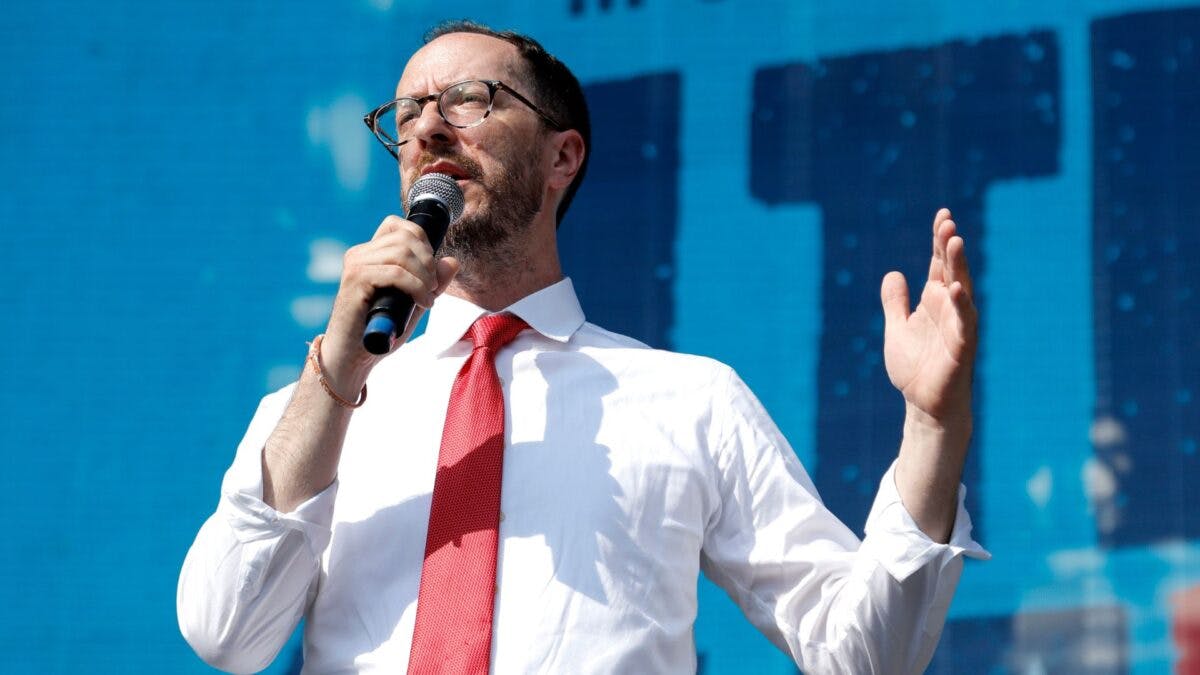
Nashville’s Democrat Mayor Doxxes ICE Agents

Nashville’s Democrat mayor released the names of multiple federal law enforcement agents with Immigration and Customs Enforcement (ICE), drawing ire from the Department of Homeland Security (DHS) and Sen. Marsha Blackburn, who say that the mayor is putting law enforcement at risk.

Mayor Freddie O’Connell’s office released information on interactions between ICE agents and Nashville emergency service personnel, dropping data that included the names of federal law enforcement personnel. O’Connell says their names were released by mistake, but the Department of Homeland Security isn’t convinced.

“They claimed it was a mistake. There’s zero chance it was a mistake and there will be repercussions,” DHS Assistant Secretary Tricia McLaughlin charged in response to the incident. “Our ICE enforcement officers are already facing a 400% increase in assaults against them and he’s essentially handing over intelligence to these criminal gangs so they can target our ICE enforcement officers. It’s wrong. It’s beneath the city of Nashville.”

The Nashville Mayor is protecting illegal aliens and gang members over his constituents.

At a time when our ICE officers are facing a 413% increase in assaults, Mayor O’Connell is doxxing the names of law enforcement agents removing criminal illegal aliens from his city.… pic.twitter.com/bKB0Ed3HSE

— Homeland Security (@DHSgov) May 29, 2025

“The Nashville Mayor is protecting illegal aliens and gang members over his constituents,” DHS charged.

The doxxing of the federal agents by O’Connell’s office comes just after Congressman Andy Ogles (R-TN) confirmed that the House Judiciary Committee and Homeland Security launched investigations into O’Connell, who condemned ICE after agents carried out enforcement operations in Nashville and signed an executive order requiring city officials to report any correspondence with ICE agents.

Sen. Marsha Blackburn (R-TN) also blasted O’Connell, accusing him of “putting ICE agents and law enforcement in harm’s way by releasing their names for criminal gangs to see.”

Get 40% Off New DailyWire+ Annual Memberships

“These men and women have risked their lives to make our communities safer by removing gangs, rapists, and other heinous criminals from our communities,” the Senator from Tennessee added. “Shame on him.”

An exclusive report from The Daily Wire revealed that, of the 196 illegal aliens arrested by ICE in Nashville in a weeklong raid, 95 had prior criminal convictions or pending criminal charges.

.@SpencerLndqst rips into Nashville Mayor Freddie O’Connell on @FoxNews over the allegations of him obstructing ICE:

“Is he on the side of the people of Nashville, the American citizens… or is he on the side of drug runners, cartel members, rapists, and sex offenders?”

🔥🔥🔥 pic.twitter.com/88YFyNFV4k

— Daily Wire (@realDailyWire) May 29, 2025

Included in the nearly 200 illegal aliens arrested by ICE in Music City are sex offenders, convicted rapists, Tren de Aragua and MS-13 members, and drug runners, as well as 31 people who reentered the United States after previously being deported, a felony offense.

Court Blocks Trump’s Tariffs. Here’s Why It’s Correct.

The Court of International Trade, which is a court that nobody has ever heard of, moved to block President Trump’s tariffs in a “sweeping ruling,” according to Reuters, that “found the president overstepped his authority by imposing across the board duties on imports from U.S. trading partners.”

The court suggested that the law under which the President of the United States was declaring these tariffs was not, in fact, capable of carrying those tariffs because the president used the International Emergency Economic Powers Act of 1977, which gives the president the power to regulate imports during certain emergency situations.

But those emergency situations do not actually extend to issues such as a trade deficit. Big trade deficits do not amount to a national emergency.

That’s what the court found — and the court isn’t wrong. If the president actually wants to impose tariffs, there are other legal mechanisms he can pursue, but this should be in the purview of Congress. It always should have been in the purview of Congress.

You don’t want any president being able to unilaterally decide that there should be massive tariffs across the board on all of America’s trading partners. That is not the balance of powers that was envisioned by the Constitution, by the Founders, the Framers.

It’s not what they wanted. It’s not something that I want either. And whether you like the tariffs or you don’t like the tariffs is irrelevant to the question of whether the president ought to have the unilateral capacity to do as President Trump did on Liberation Day and simply declare a 46% tariff on Vietnam, or a 145% tariff on China. Congress should have to sign off at some point.

Does this mean that all the tariffs are going to go away permanently? No. In fact, an appeals court has already granted a temporary stay allowing Trump’s tariffs to remain in place.

WATCH: The Ben Shapiro Show

Still, the markets spiked on the news that the tariffs would be blocked. The Dow Jones Industrial Average futures market immediately jumped significantly and then came back down to earth a little bit as the markets realized, “Oh, wait a second; it may be that President Trump is still going to be able to do some of these tariffs.”

Based on the lower court’s initial block, The Wall Street Journal reported:

The administration has already said it will appeal the ruling, and trade experts and lawyers say it has a variety of other legal avenues to prosecute the trade war that are unaffected by Wednesday’s decision.

“This is just one more bump in the tariff road that we are going to be on for as long as Trump remains in office,” said Deborah Elms, head of trade policy at the Singapore-based Hinrich Foundation, which advocates for free and open trade. “He loves tariffs and he loves the idea of being able to impose them at will, and I don’t think he’s going to give that up easily.” …

The judgment undermines the legal basis for those “reciprocal” tariffs—which the administration paused for 90 days to allow time for negotiations—that are the centerpiece of Trump’s effort to rein in the U.S.’s yawning trade deficit. The court also shot down special levies of 20% imposed on Canada, Mexico and China for their alleged role in the U.S. fentanyl crisis.

Theoretically, you could make the case that we should put tariffs on Mexico and declare a national emergency on the basis of fentanyl.

You could at least make a colorable case for that. But you could never make a colorable case that that was the case with Canada. The United States last year, in terms of fentanyl, saw something like 50 pounds of fentanyl the entire year at the border. The idea that there was a national emergency that merited a 20% tariff on Canada originally far exceeded the scope of authority originally presented to the President of the United States by that act in 1977.

There are still a bunch of other tariffs that are going to be on the books if the temporary stay is lifted. The court’s decision does not impact 25% levies that are in place on steel, aluminum, and cars because those levies were imposed using alternative legal avenues, not the national emergency situation. Those are conventional avenues. Those are known as Section 232 and Section 301 tariffs. The president does have the capacity to actually do tariffs under that sort of power, but they’re usually used for specific sectors. They are not blanket across the board giant tariffs on entire countries.

The markets were pretty happy about the lower court’s initial decision to block the tariffs. If the stay is lifted, does this mean the end of President Trump’s trade war?

No. It does mean that the president does not have the unilateral ability, by declaring a national emergency, to impose gigantic tariff regimes across the board.

And that is a good thing. I believe that we should be drawing closer trade relations with our allies and that the shot across the bow, if it was meant to get them to the table, still exists.

But the fact is that there was economic damage from the uncertainty wrought by the tariff war on our allies.

We should be gradually ramping up tariffs on China, reshoring manufacturing away from China, making closer trade alliances with countries that are more aligned with us, ranging from Vietnam to India. All of that would be good.

I don’t like the tariff policy, but that is actually a peripheral issue; whether you are a fan of the president or not, the balance of power that was drawn in the Constitution should be something that we like and want.

And that’s for this reason: I promise you, the next time a Democrat takes office, that same exact national emergency power will be used for something that you don’t like.

About Us

Virtus (virtue, valor, excellence, courage, character, and worth)

Vincit (conquers, triumphs, and wins)