When Islamists on horseback can intimidate and chase down anti-regime protesters on British streets without consequence, it raises a question no modern Briton ever expected to ask: is this still a country confident enough to protect dissent?
That is the question behind the startling suggestion from U.S. Under Secretary of State for Public Diplomacy Sarah Rogers to the Telegraph — Britons may soon be justified in seeking asylum in America. She was not being casually provocative for effect. She was serious — and each passing day strengthens her case.
With war now raging between the United States, Israel, and Iran, Britain is confronting a humiliating question: what does it say about our country when anti-Ayatollah Iranians can be harassed on British streets while police stand idly by? In Manchester, rival demonstrations erupted after the killing of Ayatollah Ali Khamenei, and reports circulated — alongside widely shared footage — that pro-regime Islamists on horseback were intimidating and chasing away Iranians near the Islamic Centre.
UK: Pro-regime Iranian enforcers chased anti-Ayatollah Iranians near the Islamic Centre in Manchester. The police declined to intervene. pic.twitter.com/HNkOOLH75p
— @amuse (@amuse) March 7, 2026
Source: @amuse/X.com
To the shock of bystanders, police made no arrests. The astounded man filming the giant steeds and their bearded Islamic riders pleaded with police to know why the men weren’t being “nicked” (that’s arrested, in Northern parlance). “They’ve just chased people with their ‘orses!” he shouts; his broad Manchester accent starkly at odds with the Middle Eastern politics playing out on his streets.
“What are we supposed to do?” shrugs the short, young police officer, “Pull him off his horse?”
“Yes!” exclaimed the terrified onlooker.
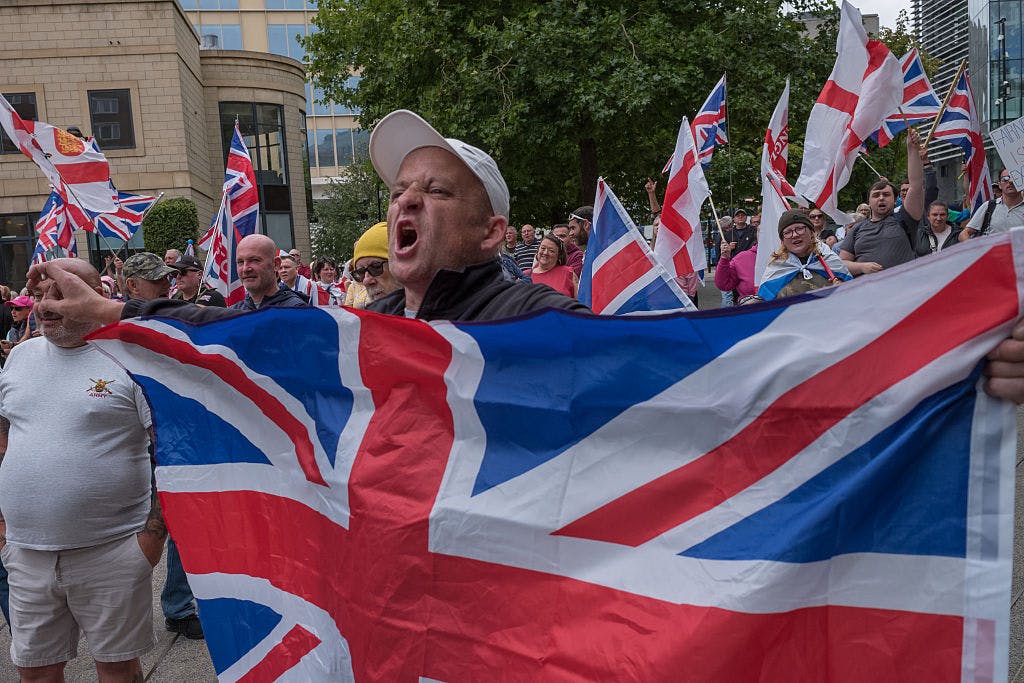
This is the state of affairs in Britain: if your safety, social norms, or free speech are being compromised by Islamic agitators, the police stand by. Our accidental documentary-maker behind the cell phone summed it up nicely, “If he had a Union Jack on, he’d be off the horse.” He’s right.
Over the past thirty years, the United Kingdom has quietly redefined the social contract that underpinned British society. But even those of us who have watched a stream of Trojan horses sneak in cultural change didn’t foresee it morphing into actual horses on our streets.
And as Rogers correctly identifies, it is all underpinned by the demise of free speech. This has fallen off a cliff: not through dramatic constitutional rupture, but via bureaucratic growth under both Left and Right-wing governments. Millions of Brits, many of whom are my viewers on GB News, are relieved that the Trump Administration has been ringing the alarm bell on our behalf.
A growing number of ordinary citizens are being swept into the criminal justice system for social media posts, venting frustration on WhatsApp groups, and even uttering unkind words at protests. There were more than 12,000 arrests in 2023 under Section 127 of the Communications Act 2003 and Section 1 of the Malicious Communications Act 1988 — laws that criminalize posting messages deemed “grossly offensive,” “indecent, obscene,” or causing “annoyance, inconvenience or needless anxiety.”
That’s roughly 33 arrests per day in a country where shoplifting is practically decriminalized, and less than 5% of home burglaries are solved.
While the laws curtailing speech were originally intended to deal with serious threats and targeted harassment, in practice, they can be applied far more broadly. Civil liberties groups argue that the vagueness of what constitutes “offensive” content allows authorities to monitor or detain people for expressing controversial political opinions, satire, or clumsy humor.
Things became more extreme with the 2023 Online Safety Act, one of the most significant legal changes of the decade, granting the communications regulator (Ofcom) wide authority to compel platforms to remove content. It also creates new criminal offenses for incidents of “false and threatening communications.” But the act’s overly broad, subjective definitions and heavy penalties will lead to the censorship of lawful and harmless speech by tech firms trying to avoid multi-million dollar fines. Hundreds of people have already been charged under the new regime for “illegal fake news” and “threatening communications,” with dozens convicted just months after it came into force.
Rogers is right to observe that this environment has produced something historically novel: a liberal democracy in which citizens increasingly self-censor not out of politeness, but out of fear.
Comedy writer Graham Linehan was arrested last September at London’s Heathrow Airport after traveling from America, where he had posted on X about protecting women’s spaces from trans-identified males.
2023 also saw the arrival of enforcement against “non-crime hate incidents,” a uniquely British invention that allowed police to record speech as hateful even when no law had been broken. The message is unmistakable: speech is tolerated only so long as it causes no discomfort to those empowered to define harm.
Contrast this with the American approach Rogers implicitly praises — the First Amendment as the cultural spine of American life. It protects speech precisely because it is offensive, destabilizing, or unpopular. American courts do not ask whether speech might cause emotional unease; they ask whether the state has any business interfering at all.
Critics will argue that Britain’s model is merely more “civilized” and that Americans fetishize absolutism. But balance presumes a neutral arbiter, and Britain no longer has one. When regulators, universities, employers, and police all share the same ideological assumptions, moderation becomes enforcement by another name.
What Rogers understands — and what many in Britain still resist — is that free speech is not primarily about manners: it is about power and control. Once the power to determine acceptable opinion shifts decisively to institutions, citizens become subjects in all but name. You may still speak, but only at your own risk.
This is why talk of asylum, literal or not, resonates deeply.
Asylum is sought not only when bombs fall, but when rights erode so completely that dissent becomes untenable. We are not quite there yet — but the trajectory is headed nowhere good. How could it? The British government is currently proposing the abolition of jury trials for all but the most heinous crimes.
America’s free-speech culture survives not because Americans are uniquely virtuous or diplomatic but because their system assumes fallibility — of governments, of majorities, of individual morality. Britain, by contrast, increasingly assumes moral consensus and builds enforcement mechanisms around it.
Sarah Rogers has done the UK a service by saying the quiet part aloud. If Britain wishes to remain a nation of free speakers rather than shy whisperers, it must relearn a lesson America never forgot: the price of liberty is not silence, but tolerance of speech we would rather not hear.
* * *
Bev Turner is a host of “The Late Show Live” for Great Britain’s GBNews, based out of Washington, D.C. Follow her on X @BeverleyTurner
The views expressed in this piece are those of the author and do not necessarily represent those of The Daily Wire.
© https://www.dailywire.com