

Same Democrats, Different Vote On Iran Terror Designation — What Changed?

Iran didn’t change — the White House did.

Just three years after Congress nearly unanimously condemned Tehran as the world’s leading state sponsor of terrorism, 53 House Democrats voted against reaffirming that same designation.

In January 2023, when President Joe Biden was in the White House, the House adopted a similar resolution condemning Iran by a vote of 420–1. The lone dissenting vote came from Rep. Thomas Massie (R-KY) — meaning every Democrat serving in Congress at the time supported the measure.

Now, with President Donald Trump leading the United States during an escalating conflict with Iran, 53 Democrats voted against reaffirming that same designation on Thursday.

The vote came on House Resolution 1099, a non-binding measure reaffirming that Iran remains the world’s leading state sponsor of terrorism, a designation the United States has maintained since 1984.

The resolution ultimately passed the House 372–53, with two members voting “present” and three not casting votes.

The party breakdown showed a stark divide. Republicans overwhelmingly supported the measure, with 215 voting in favor and none voting against. Democrats were far more split: 157 voted “yes,” 53 voted “no,” and two voted “present.”

The Democrats who voted against the resolution were:

Donald Beyer (VA), Suzanne Bonamici (OR), André Carson (IN), Greg Casar (TX), Joaquin Castro (TX), Yvette Clarke (NY), Steve Cohen (TN), Danny K. Davis (IL), Maxine Dexter (OR), Lloyd Doggett (TX), Dwight Evans (PA), Lizzie Fletcher (TX), Valerie Foushee (NC), Maxwell Frost (FL), Robert Garcia (CA), Jesús “Chuy” García (IL), Al Green (TX), Raúl Grijalva (AZ), Val Hoyle (OR), Jared Huffman (CA), Sara Jacobs (CA), Pramila Jayapal (WA), Hank Johnson (GA), Robin Kelly (IL), Ro Khanna (CA), Raja Krishnamoorthi (IL), Summer Lee (PA), Sarah McBride (DE), Morgan McGarvey (KY), Jim McGovern (MA), LaMonica McIver (NJ), James Menefee (IL), Rob Menendez (NJ), Gwen Moore (WI), Alexandria Ocasio-Cortez (NY), Ilhan Omar (MN), Chellie Pingree (ME), Mark Pocan (WI), Ayanna Pressley (MA), Delia Ramirez (IL), Emily Randall (WA), Luz Rivas (CA), Linda Sánchez (CA), Jan Schakowsky (IL), Lateefah Simon (CA), Mark Takano (CA), Rashida Tlaib (MI), Lori Trahan (MA), Lauren Underwood (IL), Nydia Velázquez (NY), Maxine Waters (CA), Bonnie Watson Coleman (NJ), Nikema Williams (GA).

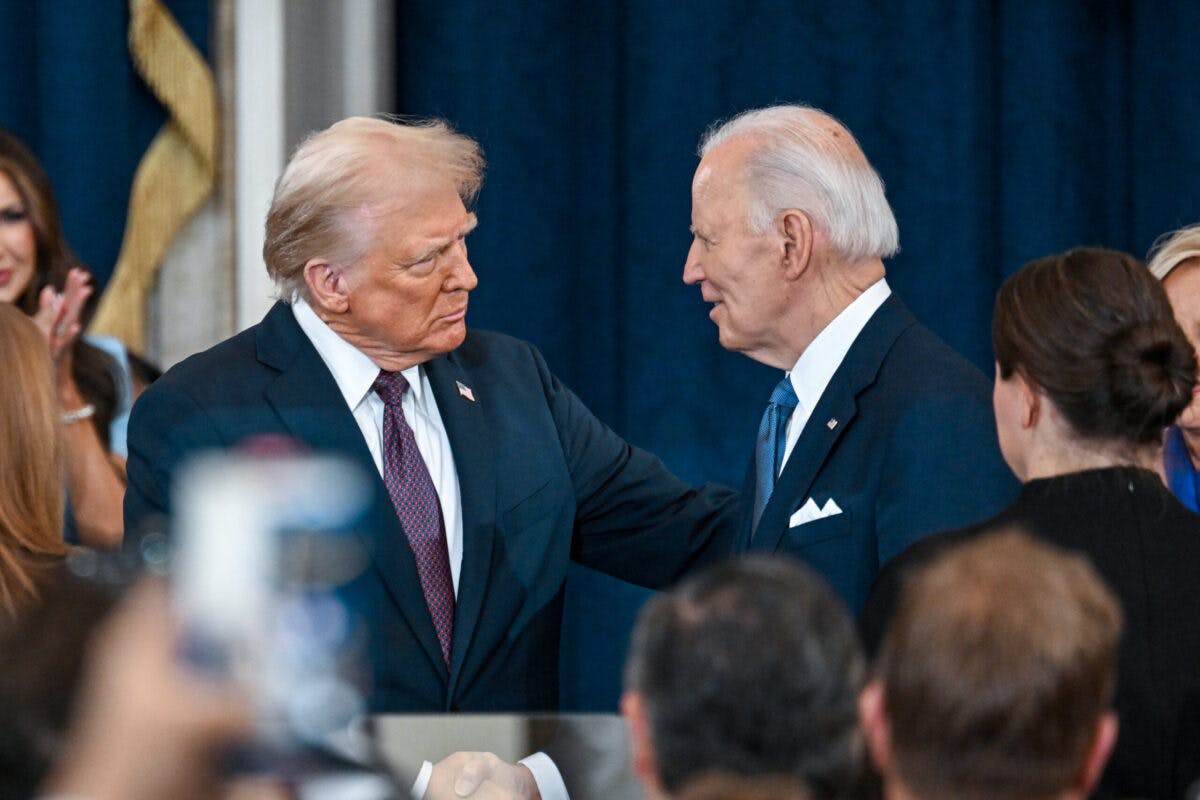
White House Press Secretary Karoline Leavitt pointed out the contrast shortly after the vote, noting that administrations of both parties have long maintained the same position: Iran is the world’s leading state sponsor of terrorism.

Republicans argued the shift reflected partisan opposition to Trump rather than disagreement about Iran’s role in global terrorism.

Rep. Brandon Gill (R-TX) said the change was obvious.

“They’re totally going off the cliff because of how much they hate the president,” Gill said. “The House voted on something substantially similar three years ago and nearly everyone supported it. Now you have 53 Democrats who won’t vote for a resolution that simply states Iran is the leading state sponsor of terrorism in the world.”

House Majority Leader Steve Scalise (R-LA) echoed that criticism, arguing Democrats opposing the measure were effectively shielding the Iranian regime.

“By denying this basic fact, these radical Democrats are defending the murderous Iranian regime and standing against America,” Scalise said.

Some Democrats, however, argued the resolution was politically motivated.

Rep. Lateefah Simon (D-CA) said in a Facebook post that she opposed the measure because she believed it was designed to justify Trump’s military actions involving Iran.

“I voted against H.Res. 1099, a Republican resolution that contains inaccuracies and is designed to justify the president’s actions,” Simon wrote.

Despite the Democratic opposition, the resolution passed overwhelmingly, reaffirming the longstanding U.S. position that the Iranian regime remains the world’s leading state sponsor of terrorism.

Can The Quran Affirm The Bible Without Contradicting Itself?

There are two basic ways to critique any belief system. You can critique it externally, by judging it according to standards it doesn’t accept, or you can judge it internally, by judging it according to standards it does accept.

Therefore, an external critique of Islam will judge it according to standards that come from outside its own sources, whether philosophical, historical, or theological, whereas an internal critique will begin from the Quran itself and ask whether Islam can stand on its own terms. 

The Islamic Dilemma is this kind of argument. It doesn’t impose Christian assumptions onto Islam. Instead, it begins with what the Quran itself says and follows those claims to their logical conclusion.

One of the strongest internal critiques of Islam is what’s commonly called the Islamic Dilemma. When followed carefully, it presents Muslims with a serious problem that can’t be resolved without undermining the authority of Islam itself.

The Quran repeatedly affirms that God revealed genuine Scripture before Muhammad, specifically the Torah and the Gospel. It speaks of these writings as guidance and light, given by Allah to earlier prophets. Just as importantly, the Quran commands Jews and Christians to judge by what God revealed in those Scriptures. Nowhere does the Quran clearly or explicitly teach that the Torah or the Gospel were lost, corrupted, or unreliable at the time of Muhammad.

The Quran doesn’t merely acknowledge earlier Scripture in passing. Instead, it repeatedly speaks of the Torah and the Gospel as real, authoritative revelations from God that were present and functioning in the world of Muhammad.

For example, Surah 5:44 states that “the Torah, in which was guidance and light,” was revealed by Allah and used for judgment.

Likewise, Surah 5:46 affirms that Jesus was given the Gospel, “wherein is guidance and light,” confirming what came before it.

These verses describe living Scriptures that guide God’s people, not lost or corrupted texts.

DailyWire+

More striking still, the Quran commands Jews and Christians to judge by these very writings. 

Surah 5:47 instructs Christians to “judge by what Allah has revealed in the Gospel.” 

Surah 5:68 tells both Jews and Christians that they have no firm standing unless they uphold the Torah and the Gospel. 

These commands only make sense if those Scriptures were accessible and trustworthy in the seventh century — when the Quran was written.

Finally, Surah 10:94 tells Muhammad himself that if he’s in doubt, he should ask those who read the Scripture before him. That appeal would be meaningless if those Scriptures were already corrupted or unreliable.

Taken together, these passages show that the Quran affirms the Torah and the Gospel as genuine revelation, present, readable, and authoritative at the time of Muhammad.

This creates a dilemma — with only two possible and mutually exclusive options.

Option one: The Torah and Gospel available in the seventh century were trustworthy.

If that’s true, then Islam faces a decisive contradiction. The Gospel preached in Muhammad’s time proclaims core Christian doctrines that Islam explicitly denies. It teaches that Jesus is the Son of God, that He was crucified, and that He rose from the dead. The Quran denies all three. So if the Gospel is trustworthy, then the Quran contradicts God’s prior revelation. That would mean the Quran can’t be from God.

Option two: The Torah and Gospel were corrupted before Muhammad.

This option also collapses Islam. If the Scriptures were corrupted, then Allah either failed to preserve his earlier revelation or allowed his followers to be misled for centuries. Worse still, the Quran commands Christians to judge by the Gospel they possess and appeals to those Scriptures as confirmation of Muhammad’s message. If those texts were already unreliable, then that doesn’t make sense. In that case, the Quran would be affirming and appealing to corrupted documents, which undermines its claim to divine wisdom.

Either way, Islam is trapped. It can’t affirm the Bible without contradicting itself, and it can’t deny the Bible without undermining its own authority.

Muslims often try to escape this dilemma by claiming that the original Torah and Gospel were pure but later altered. Yet that claim is historically unsupported. We possess New Testament manuscripts that predate Muhammad by hundreds of years, and they teach the same doctrines Christianity teaches today. There’s no evidence of a lost, non-Trinitarian, non-crucified version of the Gospel that Islam could appeal to. That so-called “original Gospel” exists only as a theological escape hatch.

The dilemma is therefore decisive. If the Bible is true, Islam is false. And if the Bible is false, then the Quran is false for affirming it. Islam depends on earlier revelation that it can’t consistently affirm or deny.

Christianity, by contrast, welcomes scrutiny of its historical claims. It stands or falls on events in history, especially the death and resurrection of Jesus Christ. If Christ didn’t rise from the dead, then Christianity is false. Islam avoids history by rewriting it centuries later, but in doing so, it contradicts the very Scriptures it claims to respect.

The Islamic Dilemma doesn’t merely challenge Islam from the outside. Instead, it exposes an internal incoherence at the heart of its theology. And a revelation that contradicts itself can’t come from God.

About Us

Virtus (virtue, valor, excellence, courage, character, and worth)

Vincit (conquers, triumphs, and wins)