
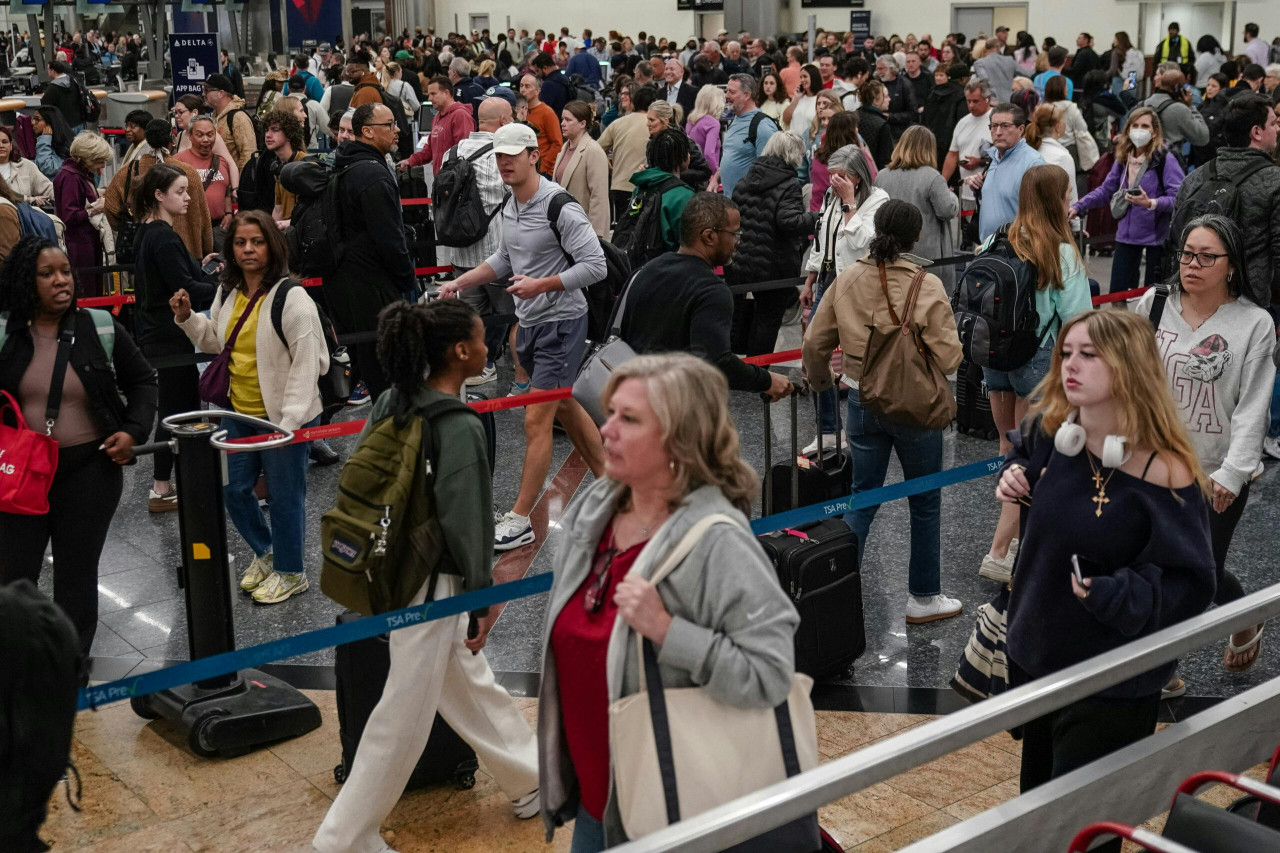
Absences among transportation security workers this weekend reached their highest since a partial government shutdown began five weeks ago, the Department of Homeland Security said on Sunday, as immigration enforcement agents prepared to fill in for them at some of the busiest U.S. airports.
Nationwide, about 11.5% of Transportation Security Administration staff were absent on Saturday, DHS said, but that figure soared to 42.4% at George Bush Intercontinental Airport in Houston, 33.4% at John F. Kennedy International Airport in New York and 33.6% at Hartsfield-Jackson Atlanta International Airport.
Overall, more than 9% of TSA employees have been absent from work over the past seven days, leading to lengthy lines for passengers trying to get to their gates, according to DHS.
To help fill the staffing gaps, hundreds of Immigration and Customs Enforcement agents will deploy to airports starting on Monday, officials have said.
DHS said on Sunday it would not publicly share details about the ICE deployment, in order to preserve operational security. Sources briefed on the matter said the current plan calls for deploying ICE agents to 14 locations, although that figure may change.
Tens of thousands of airport security personnel have been working without pay for weeks while congressional Democrats and Republicans argue over a budget for DHS.
“Many TSA officers cannot pay their rent, buy food, or afford to put gas in their cars — forcing them to call out sick from work,” a DHS spokesperson said on Sunday.
Trump announced on Saturday that ICE agents would be sent to airports unless Democratic lawmakers agree to fund DHS. Democrats have criticized the department’s immigration operations and are demanding a change in rules.
For now, ICE agents will not be deployed in areas behind security checkpoints because they lack the specific clearance needed, the sources said.
Border czar Tom Homan said on Sunday that sending out immigration agents to bolster short-staffed TSA teams will speed up airport lines, but the union for TSA workers said that does not solve what they see as the underlying problem of pay.
In appearances on Sunday news shows, Homan and Transportation Secretary Sean Duffy argued that ICE personnel can help with airport security screening, starting on Monday, even though they have not been specifically trained for it.
“When we deploy tomorrow, we’ll have a well thought-out plan to execute,” Homan said on CNN’s “State of the Union” program.
Hundreds of TSA agents have simply resigned, according to their labor union and TSA.
“ICE will do the job far better than ever done before!” Trump wrote in a Sunday morning social media post.
Details of how ICE agents would help with the lines were scant, although Homan told CNN a plan would be in place by the end of the day “to move those lines along.”
Homan and Duffy, in separate interviews, had different ideas about how the ICE agents might be deployed. Homan said he doubted ICE agents would operate X-ray baggage and passenger screening machines because they did not have experience. Duffy, in contrast, said ICE agents “know how to pat people down, they know how to run the X-ray machines.”
The labor union representing TSA workers criticized Trump’s decision, saying their members spend months in training learning to detect explosives and weapons.
“Our members at TSA have been showing up every day, without a paycheck, because they believe in the mission of keeping the flying public safe,” Everett Kelley, National President of the American Federation of Government Employees, said in a statement. “They deserve to be paid, not replaced by untrained, armed agents who have shown how dangerous they can be.”
Unlike TSA employees, ICE agents have continued to get paid by the government through a separate funding provision while lawmakers debate whether ICE funding should be tied to new rules and procedures.
Democrats have said new rules are needed after masked ICE agents fatally shot two U.S. citizens in the streets of Minneapolis earlier this year. The two had come out to protest or observe Trump’s deportation surge in Minnesota.
Hakeem Jeffries, a New York Democrat and the minority leader in the U.S. House of Representatives, told CNN that his caucus is open to a separate funding agreement for TSA employees while lawmakers debate measures to “get ICE under control.” But there has been little movement on an actual deal so far, especially in the Senate.
“We have an obligation to not fund an agency that is acting this lawlessly,” Senator Chris Murphy, a Connecticut Democrat, told NBC’s “Meet the Press” program.
(Reporting by Jonathan Allen in New York, David Shepardson in Washington and Rishabh Jaiswal in Bengaluru; Additional writing by Kristina Cooke in San Francisco; Editing by Elaine Hardcastle, Aurora Ellis, Sergio Non and Edmund Klamann)