

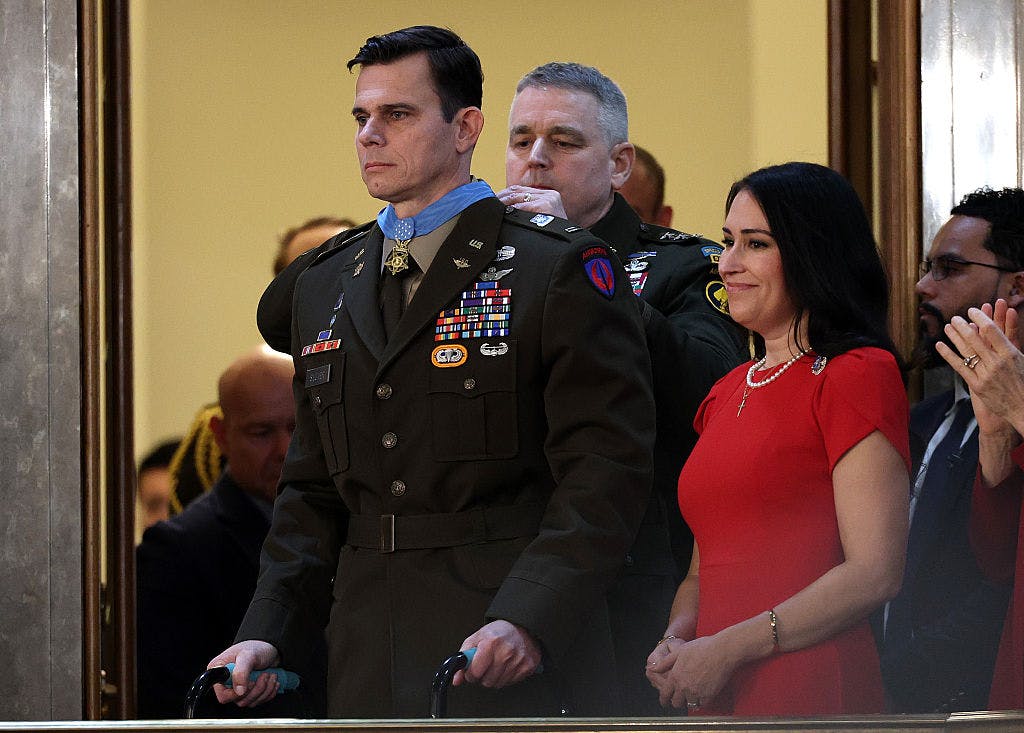
Trump Salutes American Heroes With Nation’s Highest Honors

President Donald Trump presented six of the nation’s highest honors during his State of the Union address on Tuesday, recognizing acts of military heroism and athletic excellence. 

Trump gave the Medal of Honor, the nation’s highest military award, to Army Chief Warrant Officer Eric Slover, a helicopter pilot wounded during the successful raid that captured Venezuelan dictator Nicolás Maduro. Slover was struck four times by enemy fire while preparing to land his Chinook helicopter at Maduro’s compound. 

“Eric steered the Chinook under the cover of night and descended swiftly upon Maduro’s heavily protected military fortress. This was a major military installation protected by thousands of soldiers,” Trump said. “While preparing to land, enemy machine guns fired from every angle. And Eric was hit very badly in the leg and hip, one bullet after another. He absorbed four agonizing shots, shredding his leg into numerous pieces.”

Trump also awarded the Medal of Honor to 100-year-old naval aviator Royce Williams, who fought in World War II, the Korean War, and Vietnam, flying more than 200 combat missions. 

“In 1952, Royce was in the dogfight of a lifetime,” Trump said of an encounter during the Korean War. “Flying through blizzard conditions, his squadron was ambushed by seven Soviet fighter planes. It was his first aerial combat of the war, and despite being massively outnumbered and outgunned, Royce led the takedown of four enemy jets and almost destroyed the others, vanquishing his adversaries while taking 263 bullets to his own plane and being seriously hurt. His story was secret for over 50 years. He didn’t even want to tell his wife, but the legend grew and grew.”
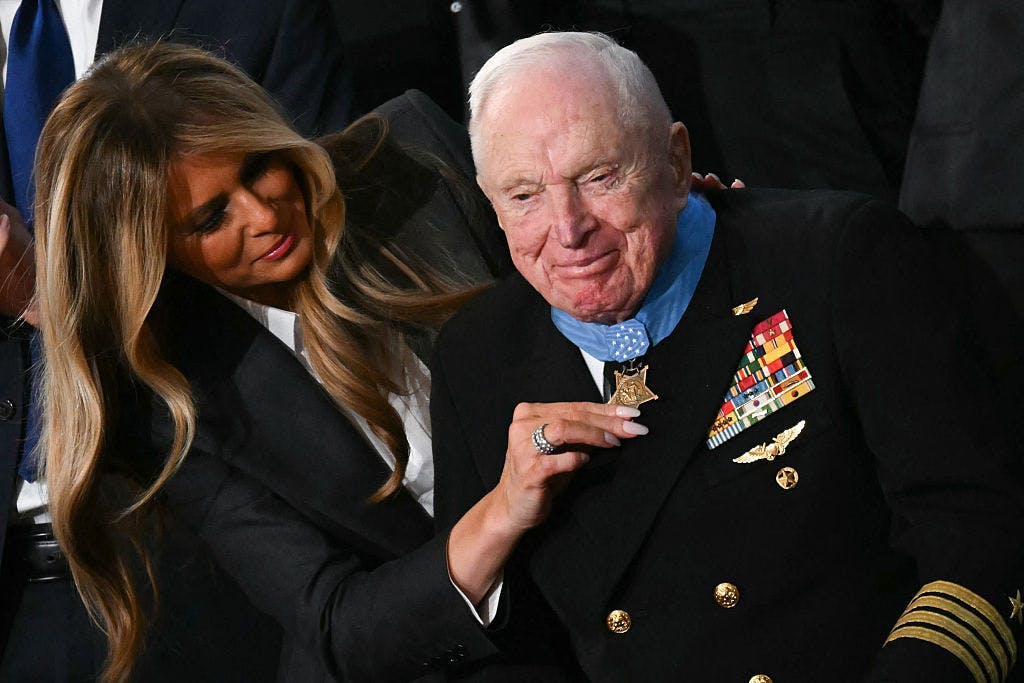
US First Lady Melania Trump presents US veteran Captain E. Royce Williams with the Medal of Honor during US President Donald Trump's the State of the Union address in the House Chamber of the US Capitol in Washington, DC, on February 24, 2026.

Credit: Photo by ANDREW CABALLERO-REYNOLDS / AFP via Getty Images.

Trump awarded the Purple Heart to Air Force Staff Sgt. Andrew Wolfe, a National Guardsman who was seriously wounded in a shooting attack in Washington, D.C., before Thanksgiving. He also presented a Purple Heart to the family of Army Specialist Sarah Beckstrom, a National Guard soldier who was killed in the same attack. 

“With God’s help, Andrew has battled back from the edge of death,” Trump said. “He’s got a little work to do, but he’s doing great.”

The man suspected of attacking them was an Afghan national who was let into the country after former President Joe Biden withdrew American forces from Afghanistan. 
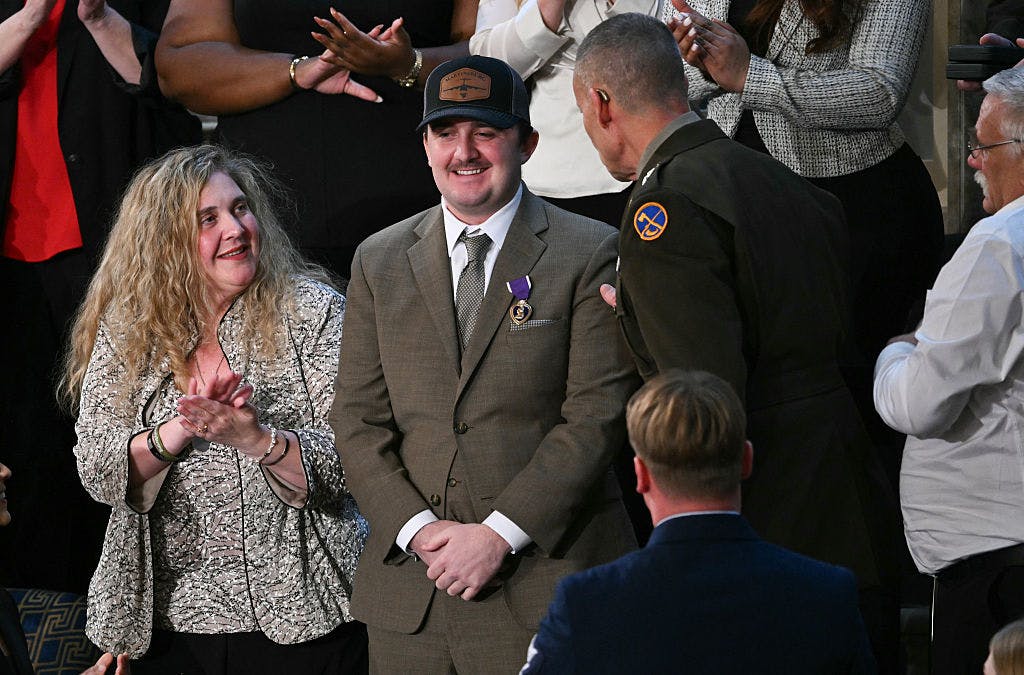
National Guard Staff Sgt. Andrew Wolfe, who survived a November 2025 shooting attack in Washington, DC, receives a Purple Heart as he is recognized by US President Donald Trump during his State of the Union address in the House Chamber of the US Capitol in Washington, DC, on February 24, 2026.

Credit: Photo by Brendan SMIALOWSKI / AFP via Getty Images.

Scott Ruskan, a U.S. Coast Guard rescue swimmer who saved 165 people during deadly flooding in Texas in July 2025, was awarded the Legion of Merit, a military decoration recognizing outstanding service. 

“It was Scott’s first ever rescue mission,” Trump said. “People watched Scott from a distance, and they couldn’t believe what they were seeing.”
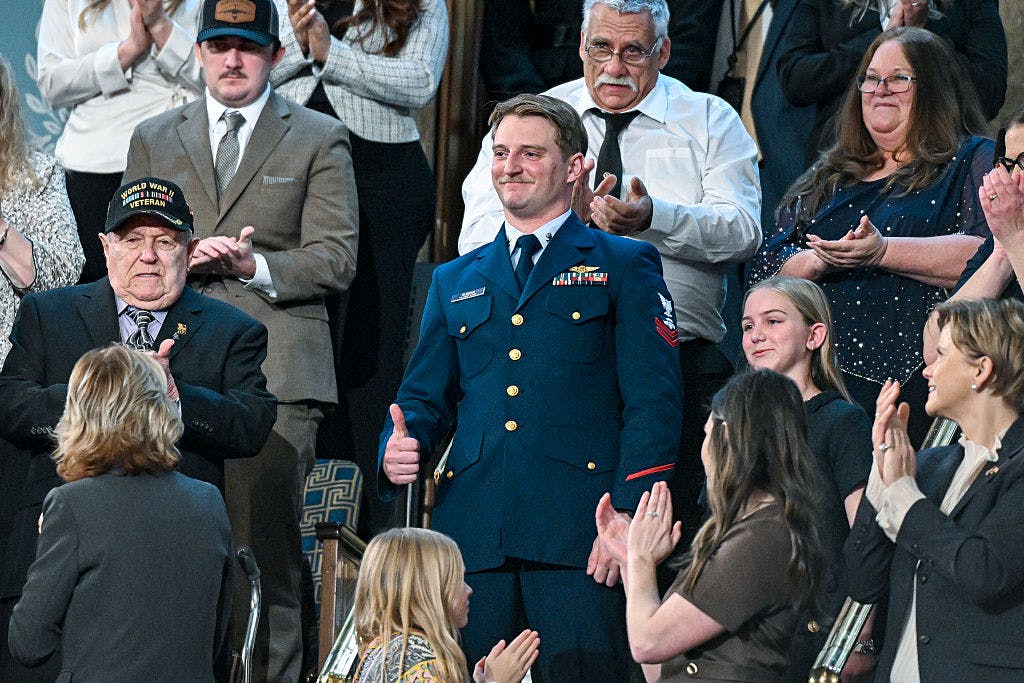
WASHINGTON, DC - FEBRUARY 24: U.S. Coast Guard Petty Officer Scott Ruskan and Milly Cate, a camper who was rescued by Ruskan during the flooding at Camp Mystic, attend President Donald Trump's State of the Union address during a joint session of Congress at the Capitol on February 24, 2026 in Washington, DC. Trump delivered his address days after the Supreme Court struck down the administration's tariff strategy, and amid a U.S. military buildup in the Persian Gulf threatening Iran.

Photo by Kenny Holston-Pool/Getty Images.

Trump also announced that he will award the Presidential Medal of Freedom, the top honor for a civilian, to Connor Hellebuyck, the goalie for the Olympic gold-medal-winning U.S. men’s hockey team. During the team’s 2-1 overtime victory over Canada in the final, Hellebuyck recorded 41 saves, including a crucial third-period stop that preserved the victory. 
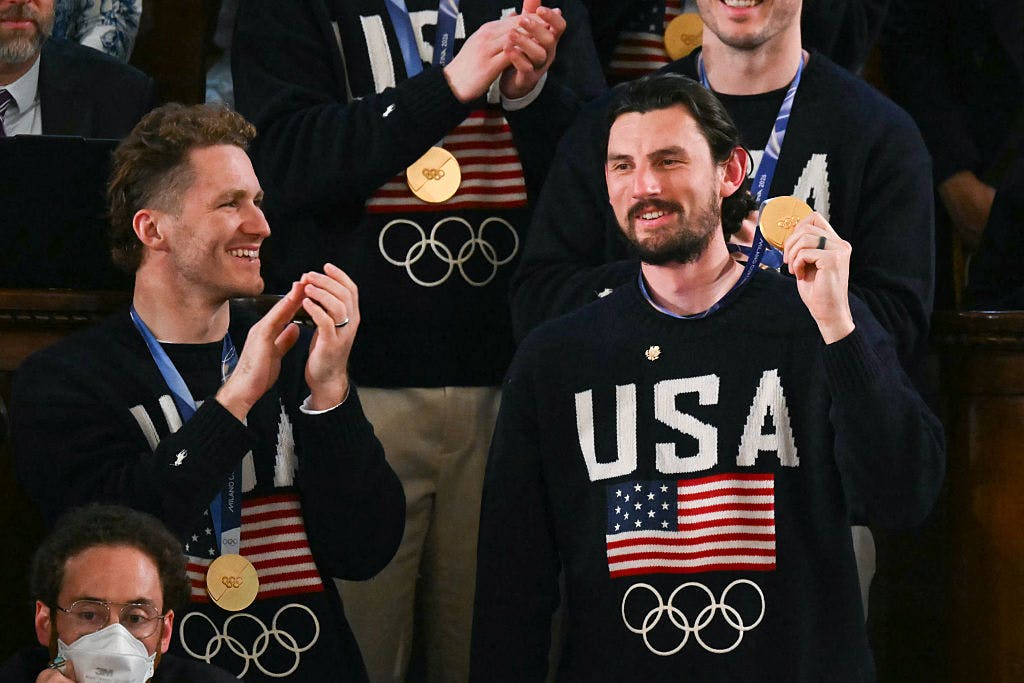
Goalie Connor Hellebuyck raises his gold medal as members of the US Men's Olympic hockey team are recogized by US President Donald Trump as he delivers the State of the Union address in the House Chamber of the US Capitol in Washington, DC, on February 24, 2026.

Credit: Photo by ANDREW CABALLERO-REYNOLDS / AFP via Getty Images.

“I’ve never seen a goaltender play as well as goalie Connor Hellebuyck,” Trump said. “I will soon be presenting Connor with our highest civilian honor.”

Trump said only around 12 other athletes have been given the Medal of Freedom in the past.
Hollywood Makes A Story Where Doing The Right Thing Still Matters

This article is part of Upstream, The Daily Wire’s new home for culture and lifestyle. Real human insight and human stories — from our featured writers to you.

***

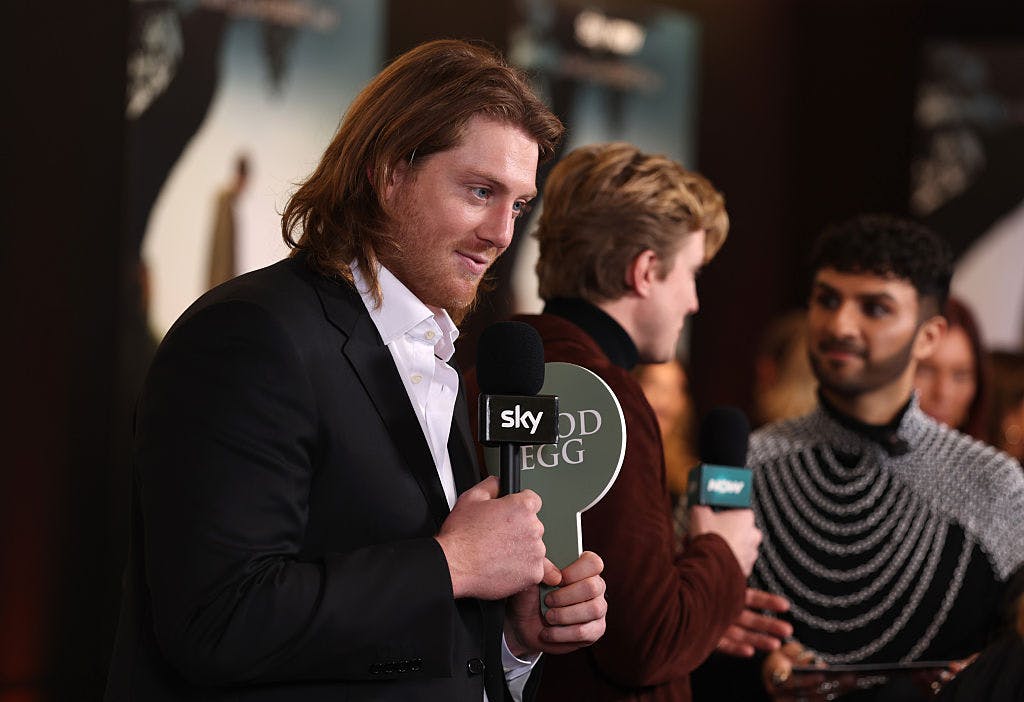
“A Knight of the Seven Kingdoms,” which aired the final episode of its first season on Sunday, has become incredibly popular, even among many conservatives who are otherwise critical of George R.R. Martin’s “Game of Thrones” universe. Movie reviewer The Critical Drinker called it “probably the best show on TV right now.”

Many on the Right have long accused “Game of Thrones” of being dark and nihilistic and subverting traditional notions of heroism. Prequel “A Knight of the Seven Kingdoms” lacks those flaws: Its protagonist, Dunk, is a clearly good person who sets out on a hero’s journey. While he’s not perfect, he’s strong and good-hearted. As he travels throughout the world, he meets compelling side characters, overcomes adversity and danger, and becomes a better, wiser person in the process.

As is typical for HBO, the series is brilliantly shot, acted, scored, and so forth. The story is well written, and you get a real sense of the characters even when they have limited screen time. Some of the more childish humor doesn’t land well, but my primary critique of “A Knight of the Seven Kingdoms” is a good one to have: It was too short. The show is excellent, and its message is a lot more complex than it may seem. (Warning: This article contains spoilers for Season 1 of “A Knight of the Seven Kingdoms.”)

After the death of Dunk’s mentor and surrogate father, Arlan of Pennytree, Dunk decides to compete in a tournament. On his way, he meets a boy with a shaved head who calls himself Egg. Egg, innocent but suspiciously well-informed about the world, wants to squire for Dunk. Dunk, however, encounters a problem: None of the lords remember who Arlan was, let alone will vouch for Dunk’s claim to be a knight — nobody, except for Prince Baelor Targaryen, the wise, even-tempered, and honorable heir apparent to the Iron Throne. With that settled, Dunk prepares to compete.

When Baelor’s nephew Aerion attacks a puppeteer over a play, Dunk leaps to her defense. Aerion’s guards subdue Dunk, but before they can do him any harm, Egg reveals himself to be Aerion’s younger brother Aegon. Dunk now has to fight for his very life: He must find six champions to fight in a trial by combat against Aerion and his six. Unexpectedly, Baelor takes Dunk’s side over that of the rest of his family because, despite the political considerations, he’s convinced of the righteousness of Dunk’s cause. Dunk prevails, only for Baelor to be accidentally slain by a blow to the head from his own brother, Maekar, the father of Aerion and Egg. In the aftermath, Dunk agrees to take Egg on as his squire, and the two head out on the road together to future adventures.

What complicates things is that Dunk’s story may all be built on a lie. The show strongly hints Dunk was never knighted by Arlan. That means that he had no right to take Egg on as a squire, no right to compete in the tournament, and no right to demand a trial by combat. Had he not told that lie, none of the events surrounding the tournament would have happened, and Baelor and the others who died in his defense would still be alive. I did not like this theory at first because I felt it besmirched Dunk’s character and the righteousness of his cause. And in one sense, it does. But in another sense, it makes the character all the more compelling.

It shows that heroism is not the sole province of the morally unblemished. If Dunk did lie, he did the wrong thing — yet it was his moral courage that got him into trouble. Regardless of whether he was one or not, Dunk still did what any true knight should have done by defending a woman from Aerion’s cruelty. Egg did the right thing by standing by Dunk and rallying men to his side. And Baelor did the right thing by putting his life on the line to defend Dunk against Baelor’s own family.

The prince’s demise is a blow to the royal family and to the whole realm, and Dunk personally feels guilt for his part in depriving the Seven Kingdoms of what would have been a great king. And yet, Dunk doesn’t take the understandable path of wallowing in his own culpability. He does the only thing he can do: try to live his life in a way that makes Baelor’s sacrifice worth it. And the best way he can do that is to shape Baelor’s good-natured but impressionable nephew Aegon into a virtuous man.

The message of “A Knight of the Seven Kingdoms is this: A hero is not a perfect person. A hero is an imperfect person who chooses to do the right thing anyway. In the short term, heroes are not always rewarded, no matter if you’re Baelor Targaryen or Ned Stark of “Game of Thrones.” But even so, it’s still important to do the right thing — both for its own sake and because it inspires the people watching you to follow in your footsteps. In our own fallen, imperfect world, that’s a lesson that’s both aspirational and applicable.

While George R.R. Martin is no conservative, his writing speaks to timeless human principles and nature that conservatives accept and liberals reject. “A Knight of the Seven Kingdoms” is doubtless a more traditional story than is typical for Martin. And yet, it still explores what he describes as the key theme of his work: the human heart, in conflict with itself. On that topic Dunk the Lunk, thick as a castle wall though he is, has a lot to teach us.

* * *

Stephan Kapustka is a writer at the American Spectator. Follow him on X @SteveKapustka.

The views expressed in this piece are those of the author and do not necessarily represent those of The Daily Wire.

About Us

Virtus (virtue, valor, excellence, courage, character, and worth)

Vincit (conquers, triumphs, and wins)