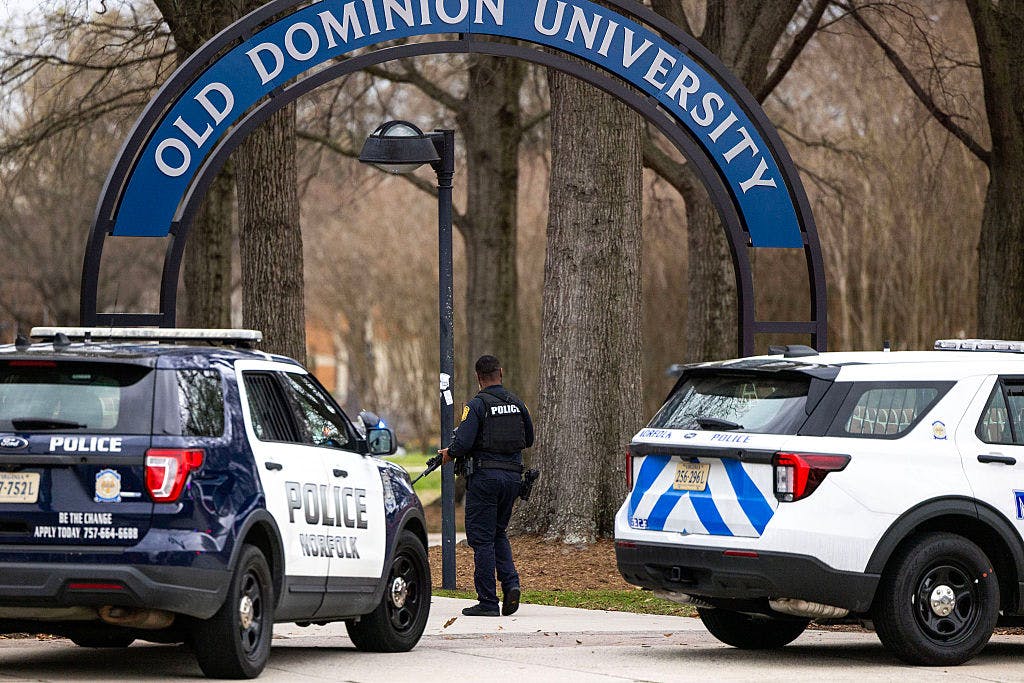
It’s never a good sign when news anchors begin struggling to keep track of all the Islamic terror attacks that are occurring throughout the United States. You see, it used to be that, when a jihadi tried to commit mass murder, there would be some sort of “cooling off period” before the next attack. But that wasn’t the case a few days ago, as jihadists — within the span of just two hours — attempted to commit mass murder in two separate locations: a college campus in Virginia and a synagogue in Michigan. And that left news producers and anchors scrambling to cover what was happening.
Here’s how the local affiliates at Fox responded, for example:
Source: Fox Now/YouTube.com
He’s having to pivot from one terror attack to another on the same day. It’s not exactly a ringing endorsement of post-9/11 foreign policy in this country, which doubled the Muslim population in the United States.
But the bigger issue with that footage is what came next.
We’re told that the shooter was “a man from Northern Virginia who previously served time for providing support for ISIS.” There’s a lot to think about in that sentence, starting with the fact that the shooter was not, in fact, a man from Northern Virginia.
36-year-old Mohamed Bailor Jalloh was actually a man from West Africa, specifically the poor Muslim nation of Sierra Leone. And although we don’t know the precise timeline — the government won’t release it — we do know that, at some point, he became a naturalized citizen of the United States. As part of that process, he was required to pledge his loyalty to this country and its Constitution. Jalloh also served in the Virginia Army National Guard from 2009 to 2015. And for the media, that’s one of the most important parts of his biography.
Watch:
Source: ABC 7/YouTube.com
So she picks the single most muddled and incomprehensible way to describe what happened. And then she says, “I don’t know how else to say it.” The best she can come up with is: the cadets “rendered him no longer alive.” And then a reporter has to play “Guess Who” and asks her if the cadets used a gun. And she says no, they definitely didn’t use a gun.
Not to play mind reader here, but putting two-and-two together, we can conclude that the final moments of Mohamed’s life were not exactly pleasant. The cadets saw this terrorist murder their instructor. And in response, they stabbed, bludgeoned, and stomped him to death. (And indeed, it was later reported that one of the cadets used a knife). In other words, just like the terrorist in Michigan who attacked the synagogue, Mohamed Jalloh wasn’t stopped by the police. He was stopped by his potential victims — people who only survived because they were armed with a weapon of some kind.

But the bigger part of the story — which every mainstream media outlet has decided to obfuscate as much as possible — is why Mohamed Bailor Jalloh was allowed to remain in this country in the first place. Like the terrorist who attacked the synagogue, and like the terrorist who shot 18 people in Austin, and like the parents of the two New York City bombers who tried to kill Jake Lang, Mohamed Bailor Jalloh was a naturalized citizen of the United States. Our government, without any obligation to do so, awarded citizenship to all of these terrorists. And you might say — well, “we had no idea that they’d become terrorists. We had no idea that there was any connection between Muslims and anti-Western, anti-Christian violence.”
But even if you buy that logic, which is absurd on its face, the problem is that Mohamed Jalloh remained a naturalized citizen even after he pleaded guilty in 2017 to providing material support to ISIS. He quite literally swore allegiance to a foreign enemy that wants to destroy the West. We didn’t take away his citizenship even after he did the one thing that, under our current law, would obviously justify it. And the more you dig into this story, the more disturbing and inexcusable it becomes. We’ll start with this news report I found in the archives of CBS News. It’s from 2016, when Jalloh was first arrested.
Watch:
Source: WTVR CBS 6/YouTube.com
Apparently, the gun store could tell right away that he was probably a terrorist. So they sold him a gun that didn’t work (probably after contacting the FBI). This is the kind of thing that would prevent a lot of mass shootings if more gun stores did it. If someone looks like a terrorist — if he’s a lone Muslim with bad paperwork who keeps demanding that you sell him an assault rifle, or if he’s a blue-haired man who insists that you call him a woman — then you have the option of refusing to sell that person a firearm and ammunition. And in doing so, you can save a lot of lives. Just by using basic common sense, you can stop the vast majority of mass shootings — and you can mitigate the damage when they do occur.
But in this case — just like we see in many, many other cases — common sense came to an abrupt end once the legal system took over. A federal judge named Liam O’Grady (who, appropriately enough, was appointed by George W. Bush) decided to give Mohamed Jalloh a sentence of just 11 years in prison, with credit for time served. That was roughly half the sentence that the Justice Department was seeking. We’ll talk about why the judge might have handed down that sentence in a moment.
In addition to the light sentence, Jalloh was allowed to leave prison two and a half years early, because he completed a “drug treatment program.” You see, in court, he stated that he had been abusing drugs because of a bad breakup, after dating a woman for several years. This is one of those excuses that isn’t actually an excuse at all. If anything, it makes the crime worse. If you’re going to commit an act of terrorism because you got dumped, then you’re liable to fly off the handle whenever you face any kind of setback, no matter how minor. But apparently, in our court system, this is exactly what you need to say. And although these “drug treatment programs” are only supposed to shave a year off your sentence at most, Jalloh got out more than two years early. No one can explain that. He just … got out of prison early.
At that point, the moment he got out of prison, in December of 2024, he should’ve been detained by the feds and placed in denaturalization proceedings. But the Biden administration didn’t do that, even though Jalloh’s plea deal — by itself — was evidence that he had lied on his application for citizenship. And then, when the Trump administration took over, they didn’t attempt to deport him either. So why didn’t that happen? Why was this self-described terrorist allowed to remain in the United States and continue to plan to murder American citizens in the name of global jihad? Why did two administrations — one Democrat and one Republican — allow this to happen?
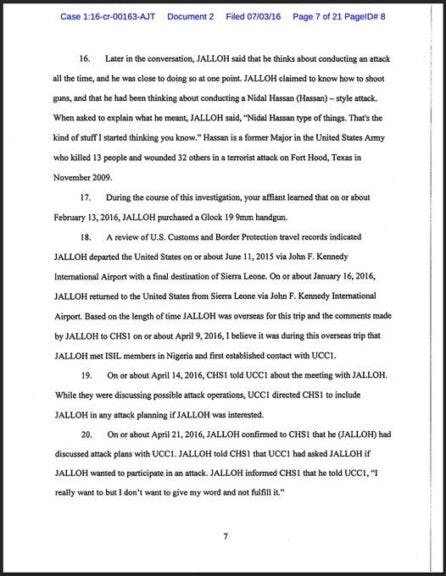
To answer that question, we need to take a closer look at Mohamed Jalloh’s arrest. In June of 2015, he traveled to Sierra Leone, only returning to the United States in January of 2016. In that period, he met with ISIS members in Nigeria and first came in contact with an FBI informant. In February of 2016, he purchased a Glock handgun. And concerning an attack on the United States, he said, “I really want to but I don’t want to give my word and not fulfill it.”
In April 2016, Jalloh began speaking to an informant about his love for an Al-Qaeda cleric, and provided more indications that he desired to commit acts of terrorism in the United States. Jalloh explained that he quit the military and “thinks about conducting an attack all the time, and he was close to doing so at one point.”
Jalloh also said, “Sometimes you just have to take action… you can’t be thinking too much… you have to pick a action and take it cuz time is not on your side.”
In particular, Jalloh expressed an interest in conducting an attack on the U.S. military. He described Mohammed Abdulaziz — who killed five members of the U.S. military in a terrorist attack in Tennessee in 2015 — as a “very good man.”
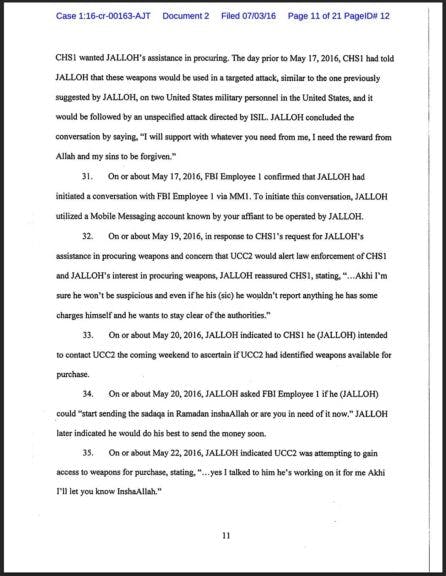
He also told a confidential human source for the FBI that he was contemplating a “Nidal Hasan-style attack,” referring to the Muslim former U.S. Army Major who killed 13 people and wounded 32 others during an attack on Fort Hood in November 2009. Eventually, Jalloh was connected directly with an undercover FBI agent, where he indicated he was interested in obtaining weapons for an attack on “military personnel in the United States.” He also sent $500 to an online account that appeared to belong to ISIS, although it was actually controlled by the FBI.
That’s how the government described Jalloh’s crimes — which again, he pleaded guilty to committing. But if you look through the court filings from his attorney, as the journalist Ford Fischer did, then you’ll find that Jalloh’s attorneys offered a different perspective about what exactly the FBI told him. The attorneys argued that, while Jalloh did indicate a willingness to commit an act of terrorism in the abstract, he wasn’t actually serious about committing an attack himself. And that’s important because, in this case, there are reasons to believe that Jalloh’s attorneys were telling the truth. First of all, all of the texts, emails, and phone conversations were recorded. So if the attorneys decided to lie about the contents of those communications, they might compromise his plea deal (and his lenient sentence). Instead, they got the plea deal they wanted — complete with a light sentence, which indicated that the judge thought their argument was persuasive. And the prosecutors didn’t object to how Jalloh’s lawyers characterized these conversations, either.
So with that in mind, it’s important to consider the argument from the defense. According to the lawyers, when Jalloh was first invited by the confidential informant to participate in an “operation” on American soil, he initially “responded with ambivalence.” Shortly afterwards, he explicitly, “refused to participate.” He wasn’t interested in committing an act of terrorism. Instead, he met with the informants for, “the express purpose of trying to meet a Muslim woman to marry.” So in this version of events, he was a down-on-his-luck guy, kind of a loner and a loser — exactly the type of person the FBI has targeted in the past (for example, the fake Gretchen Whitmer kidnapping plot).
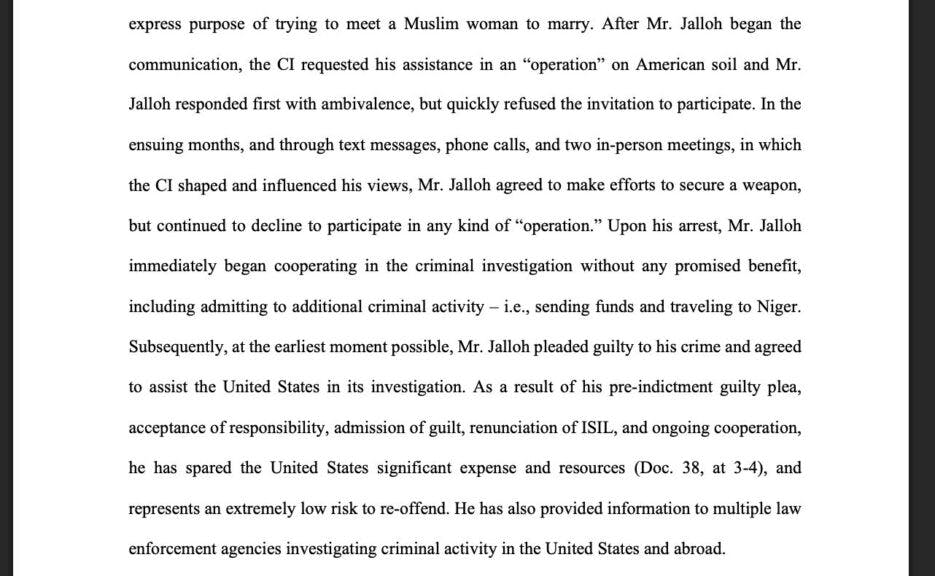
Over the next few months, according to Jalloh’s attorneys, the FBI informants “shaped and influenced his views” using “text messages, phone calls, and two in-person meetings.” During these conversations, he agreed to secure a weapon and provide funding, but “continued to decline to participate in any kind of operation.”
We have no way of knowing exactly what the FBI said during these text messages and phone calls, because they’re not public record. That’s one of the benefits of a plea deal, from the government’s perspective. It keeps the evidence hidden. The government and the judge have access to the evidence, but no one else does.
At the same time, it’s no secret that the FBI — as a matter of policy — routinely uses informants to convince targets to engage in criminal activity. Additionally, the FBI has been known to protect terrorists who have a connection to its informants. Not many people know this, because the government tried to hide it, but the father of the Pulse nightclub shooter was an FBI informant for more than a decade — right up until the moment of the massacre in June of 2016, in which 49 people died. And that’s significant because several years earlier, in 2013, the FBI investigated the Pulse shooter (Omar Mateen) after he told his co-workers that he had connections to al Qaeda. But that investigation went nowhere, evidently. Then the next year, the FBI opened a second investigation into Mateen, due to his relationship with a Florida man who traveled to Syria to become a suicide bomber. That investigation also went nowhere.
What might be the reason these investigations went nowhere?
This is from The Intercept.
An FBI intelligence report indicates that agents told an unidentified undercover informant that they were investigating Mateen. The informant then ‘became very upset’ that Mateen was under scrutiny, according to the report. Although neither federal prosecutors nor the FBI has confirmed that the unidentified informant in the report was Mateen’s father, defense lawyers for Noor Salman [the shooter’s widow] assert that they “can now infer” that [the father] “played a significant role” in the FBI’s decision to close the assessment and not to pursue a larger investigation or criminal charges against Mateen.
Prosecutors, and the FBI director at the time (James Comey), tried to hide this arrangement for as long as possible. They also downplayed the fact that the FBI launched an investigation into Mateen’s father after “finding evidence he made money transfers to Turkey and Afghanistan in the months leading up to the shooting.”
So let’s take this back to the case of Mohamed Jalloh. Did the federal government see him as a potential informant to be protected? Did they buy his story that he was “reformed,” and deliberately spring him loose in order to set more “traps” for other terrorists? This isn’t a far-fetched conspiracy. The FBI does it all the time.
They’ve also been known to encourage terrorists to commit mass shootings. In May 2015, at a convention center in Garland, Texas, there was an event called the “First Annual Muhammad Art Exhibit and Contest” where people drew cartoons of Mohammed, as a kind of free speech exercise. The police were prepared for a potential terror attack, so they had police officers, SWAT teams, and snipers standing by. And indeed, a terror attack took place.
This is from CBS:
The terror attack in Garland, Texas, was the first claimed by ISIS on U.S. soil. It’s mostly been forgotten because the two terrorists were killed by local cops before they managed to murder anyone. In looking into what happened in Garland, we were surprised to discover just how close the FBI was to one of the terrorists. Not only had the FBI been monitoring him for years, there was an undercover agent right behind him when the first shots were fired..
Yes, an undercover FBI agent was “right behind” the shooter. And no, the FBI agent didn’t neutralize the shooter. Local police did that. And it gets worse when you look at what exactly the FBI agent was telling the shooter.
Watch:
Source FOX 4/YouTube.com
They whisk the undercover operative away, without providing any kind of explanation for what he was doing over the last several months. And that’s it. The story just died, along with the two terrorists. No one asked anymore questions.
That seems to be the goal with the case of Mohamed Jalloh, as well. No one in the federal government has explained why he wasn’t denaturalized and deported, or why he got out of prison early, or what the FBI agents were telling him to do when he insisted he didn’t want to commit an act of terrorism. No one has explained why, at every turn, the government took steps to help the terrorist, rather than protect Americans from him.
If you’re the cynical type, you might conclude that maybe there’s some authoritarian political motivation here. You might point to the fact that, the same week that Jalloh opened fire in Virginia, a Virginia state senator named Saddam Azlan Salim — yes, his name is literally “Saddam” — helped pass a major, unconstitutional anti-gun bill he sponsored, which prohibits so-called “assault firearms.” According to Fox, the law would “ban a wide range of firearms and features, including semi-automatic center-fire pistols with magazines exceeding 15 rounds, rifles with detachable magazines and weapons with certain characteristics such as collapsible or thumbhole stocks and threaded barrels.”
Is this the kind of result the bureau is hoping for? Is it the result that the DOJ is hoping for? Is that why they don’t de-naturalize anyone — even the self-described domestic terrorists? We really don’t know. The only alternative explanation is that they’re just extraordinarily, historically incompetent, to a degree that’s truly hard to comprehend.
Either way, assuming nothing changes, which is a very safe assumption, we can conclude that our leadership class has implemented a regime in which, number one, you subsidize foreigners who hate you and try to kill you, and number two, when they do kill you or your neighbors, they use that as a pretext to strip everyone’s constitutional rights.
And it’s not just Democrats who are doing this.
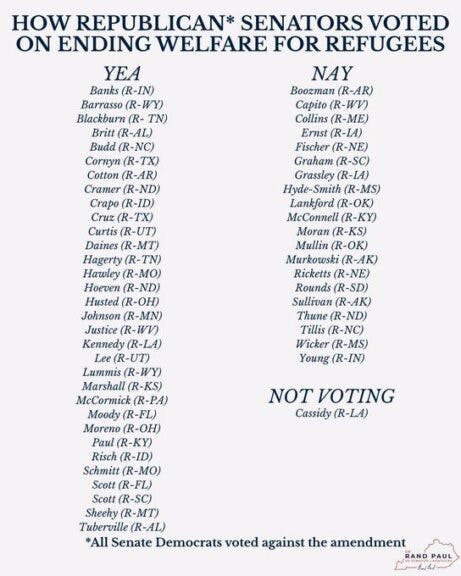
Nearly two dozen Republicans in the Senate just voted against legislation that would strip welfare funding from so-called “refugees.”
Source: @SenRandPaul/X.com
Again and again, our leaders are taking the side of foreign invaders. And they do it because they can get away with it. Millions of people, myself included, have called for the full and unredacted list of “Epstein Files.” But no prominent political figure or journalist has called for the release of all FBI correspondence with “Mohamed Jalloh,” or the Garland shooters, or the Pulse shooter’s father. Nor is there any interest in why the Trump administration — which pledged to dramatically increase the number of denaturalization proceedings — simply hasn’t done so. What are they doing to ensure that we never offer citizenship to another anti-American third-world invader ever again? Are they doing anything?
These are not academic issues, especially now that we’ve gone to war against Iran, which has 90 million Muslim citizens. And this is after 20 years of the floodgates being open, with the entire Arab world invited to come settle within our borders. So these acts of terrorism will continue, at an ever-increasing pace, unless the government starts de-naturalizing and deporting a lot more of these foreigners. Until that happens — and it may never happen — we have to do exactly what they did in Michigan and Virginia. We have to be ready to defend ourselves. We certainly can’t rely on anyone else to do it for us.
© https://www.dailywire.com