

It’s time to ask some serious questions.
When you get to the airport next week, a record 171 million of us will get on a plane this spring. Will you be safe?
When you look at the southern border or when you read about Sheridan Gorman, 18 years old, shot in the head while going out for a walk with friends to see the Northern Lights, do you feel safe?
You may even be reading this in line at an airport right now, probably waiting for hours if you are. That is because Democrats decided to shut down funding for the Department of Homeland Security in order to punish Immigration and Customs Enforcement (ICE) — which is a part of DHS — for enforcing the law.
It doesn’t matter that ICE’s legal authority has not changed for decades.
It doesn’t matter that under President Trump, they’re simply doing their job for the first time in decades. DHS must be closed down because ICE is doing their job.

Democrats don’t want to enforce the border. If they get the chance, they’ll return to Biden-era open borders as soon as possible.
Sheridan Gorman, an 18-year-old student at Loyola University in Chicago, was murdered by a masked man while she was walking in Rogers Park last Thursday.
According to CBS News:
The shooting happened early last Thursday as Gorman, 18, was walking with her friends near the pier at Tobey Prinz Beach at Pratt Boulevard to take in the Chicago skyline. Prosecutors said, as Gorman and her friends were walking toward the lighthouse at the end of the pier shortly after 1 a.m., Gorman told her friends she saw someone hiding behind the lighthouse. When Medina came out from behind the lighthouse, Gorman and her friends ran away, and Medina shot Gorman in the back. The bullet exited her neck.
The alleged murderer was a Venezuelan national in the United States illegally, according to the New York Times. Medina was released into the United States by the Biden administration in May 2023 after he had contact with Border Patrol agents. According to federal officials, Medina was arrested on suspicion of shoplifting in Chicago in June 2023, and then released.
Gigantic shock.
You might ask yourself: If someone is arrested for shoplifting and they are an illegal immigrant, why are they still here?
The answer, of course, is that Chicago is a sanctuary city. That means that the city and state of Illinois, a Democratic state, prevent local officials from cooperating with federal law enforcement. That is why Medina was free to allegedly commit a cold-blooded murder.
If local law enforcement had notified ICE that they’d arrested an illegal immigrant and then held him until ICE arrived, Gorman would probably still be alive. Republicans up to and including President Trump have pointed out that simple fact.
Senator Ted Cruz correctly pointed out, “Gorman’s killer was an illegal alien who should never have been in our country. Joe Biden’s open border policies and Governor Pritzker’s refusal to accept President Trump’s help are the reasons why she is not with us today.”
Correct.
President Trump said, “It’s devastating. These people were let in by Biden. We’re getting them out. We’re getting them out fast. That’s why ICE is so important. They’re doing such a good job. This … this animal — I saw the whole thing last night, they gave me a briefing — came in through Joe Biden with his open door policy and his border czar Kamala, who never saw the border.”
Democrats, however, are still making excuses. A Chicago alderman named Maria Hadden actually speculated it might have been Gorman’s fault.
You see, when you get shot in the back of the head by an illegal immigrant who was hiding while you were out seeing the Northern Lights, it’s possible that it’s your fault for startling that illegal immigrant. It’s like walking into an endangered species arena at the zoo or something. It’s your fault if something bad happens to you.
She said: “Then they go out on the pier, they walk around. So the kids were out doing normal, normal things people do in the neighborhood. And it sounds like this might have been a wrong place, wrong time, running into a person who had a gun. They might have startled this person at the end of the pier, unintentionally.”
Other Democrats, of course, are claiming that this is all happening because we incarcerate too many criminals.
This is the big Democratic move: It’s been true for decades. The idea is that criminality happens because too many criminals are in jail. It’s sort of like the argument that if you kill too many terrorists, you’re just creating new terrorists.
Which is weird because when you kill terrorists, then they’re dead. The same thing is true of people who are in jail: When they’re in jail, you know what they’re not doing?
They’re not on the streets shooting people.
And yet, this is the typical Democratic take. It is idiotic.
Chicago Mayor Brandon Johnson said back in November 2025, “We cannot incarcerate our way out of violence. We’ve already tried that, and we’ve ended up with the largest prison population in the world without solving the problems of crime and violence, the addiction on jails and incarceration in this country. We have moved past that. It is racist. It is immoral. It is unholy, and it is not the way to drive violence down.”
I beg to differ. I think it’s a great way to drive violence down. Keeping criminals in jail is a great way for them not to commit crimes against people on the streets, because they’re in jail.
Governor J.B. Pritzker’s office issued this statement: “Our thoughts are with the family, friends and Loyola University community grieving the senseless murder of Sheridan Gorman. Violent crime has no place in our streets. We expect the alleged perpetrator to be held accountable to the fullest extent of the law. The Trump administration needs to stop politicizing heinous tragedies and instead focus on real solutions, like reinstating federal funds to prevent violence that support our public safety efforts.”
That’s crazy. Politicizing heinous tragedies instead of focusing on real solutions? It is not politicization to point to the specific policy that could have stopped this murder in the first place. In fact, it is playing politics to ignore that policy for political reasons.
But Democrats are addicted to playing politics on illegal immigration. They’ve decided that illegal immigrants are the finest among us and deserve our undying sympathy, and that we ought to defund the agency that houses ICE in order to facilitate illegal immigration.
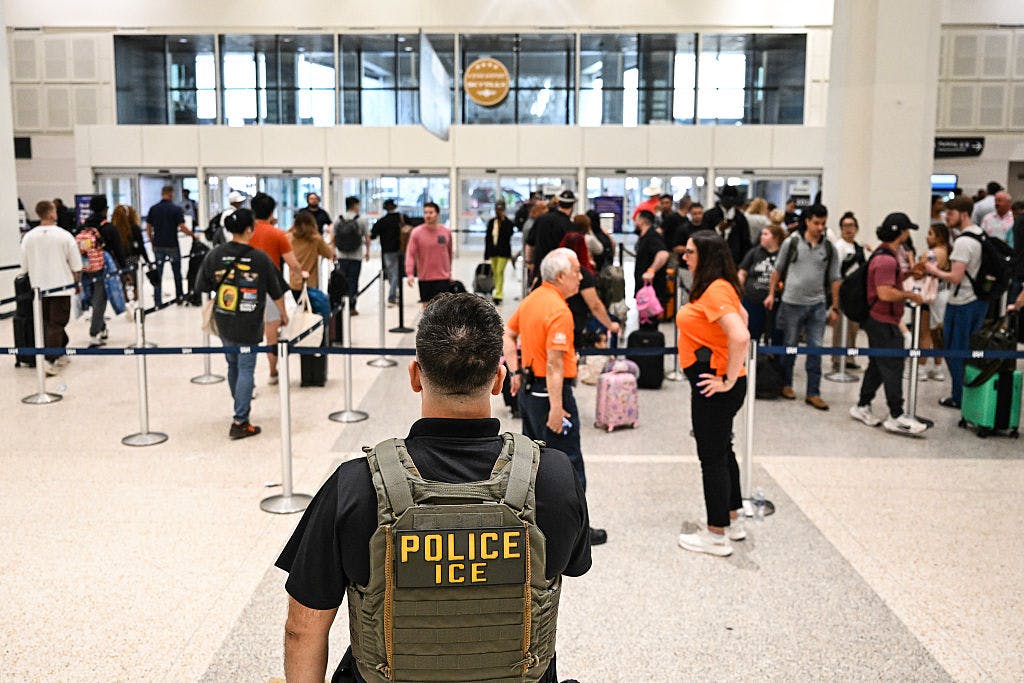
Meanwhile, the partial DHS shutdown has had the effect not just of defunding ICE, but defunding the TSA — in the middle of a war. This initially led to gigantic lines around the country at airports. In response, the administration said that it will deploy ICE officers to man the TSA lines because ICE actually has some leftover funding from the last round of funding.
Now, even CNN is saying ICE is helping with wait times.
If safety is your number one issue, I don’t see how you can vote Democrat.